
Last Updated: November 7, 2026
Quick Summary
The best budget lenses for portrait photography combine a fast aperture of at least f/1.8 with a proven portrait focal length. Top picks include the Canon RF 50mm F1.8 STM, Canon EF 85mm f/1.8 USM, Sigma 56mm f/1.4 and Sony FE 85mm f/1.8. Check current listings, since prices move constantly.
- Every lens on this list opens to at least f/1.8 or wider and covers a proven portrait focal length.
- The Sigma 56mm f/1.4 has the widest aperture on this list at f/1.4.
- On an APS-C body, a 56mm lens behaves like roughly an 85mm lens on full frame.
- The best aperture for portraits is usually between f/1.8 and f/2.8.
- When buying used, reject deep scratches, fungus or heavy haze in the glass.
Table of Contents
- How We Picked These Budget Portrait Lenses
- Quick Comparison: Budget Portrait Lenses at a Glance
- 1. Canon RF 50mm F1.8 STM: The Default Budget Prime
- 2. Canon EF 85mm f/1.8 USM: Short Telephoto for DSLR Shooters
- 3. Sigma 56mm f/1.4: APS-C Portrait Specialist
- 4. Canon RF 24-105mm F4-7.1 IS STM: One Zoom, Many Focal Lengths
- 5. Sony FE 85mm f/1.8: The Sony Portrait Standby
- The Best 50mm Lens for Portraits on a Tight Budget
- 50mm vs 85mm for Portraits: Which Focal Length Fits Your Work
- The Best Aperture for Portrait Photography (and When to Stop Down)
- Used Camera Lenses for Portraits: What to Check Before You Buy
- Frequently Asked Questions
How We Picked These Budget Portrait Lenses
Portrait photography does not require a five-figure lens collection. The best budget lenses for portrait photography share three traits: a fast maximum aperture, a focal length that flatters faces, and a price that leaves room for a decent tripod, which is why budget lenses dominate this list. We built this list around what actually matters when you shoot people.
Our criteria were simple. Every lens here opens to at least f/1.8 or wider and covers a proven portrait focal length. We weighted five factors: maximum aperture, focal length, mount availability, used-market supply, and value for money. We did not rank by brand loyalty.
Below, we break down nine options, explain which focal length suits which workflow, and show you exactly how to vet a used copy before you pay.
Quick Comparison: Budget Portrait Lenses at a Glance
Here is the short version. Each lens below earns its place for a different reason.
| Lens | Focal Length | Max Aperture | Mount | Best For |
|---|---|---|---|---|
| Canon RF 50mm F1.8 STM | 50mm | f/1.8 | Canon RF | First portrait prime |
| Canon EF 85mm f/1.8 USM | 85mm | f/1.8 | Canon EF | DSLR shooters |
| Sigma 56mm f/1.4 | 56mm | f/1.4 | APS-C mounts | Crop-sensor portraits |
| Canon RF 24-105mm F4-7.1 IS STM | 24-105mm | f/4-7.1 | Canon RF | One-lens flexibility |
| Sony FE 85mm f/1.8 | 85mm | f/1.8 | Sony E | Sony short telephoto |
Focal Length
A note on pricing: lens prices move constantly, especially on the used market, so we have deliberately left figures out. Check current listings before you commit. If you are new to buying secondhand, our guide to essential accessories for new camera owners covers the extras you will want alongside your first lens.
1. Canon RF 50mm F1.8 STM: The Default Budget Prime
The Canon RF 50mm F1.8 STM is a common first choice for Canon RF shooters. It pairs a classic 50mm perspective with an f/1.8 maximum aperture, which is exactly the combination that makes portraits pop.
Why this one? A 50mm prime on full frame sits close to how the human eye sees the world, so framing feels natural and you can shoot in tight spaces. The f/1.8 aperture blurs backgrounds enough to separate a subject from a busy street.
What most guides miss: this is a gateway lens, not a forever lens. Most people eventually add an 85mm for tighter headshots. Start here anyway. You will learn more about aperture and distance from a cheap 50mm than from any zoom.
Best for: Canon RF users buying their first portrait prime.
Skip if: you mostly shoot tight head-and-shoulders work and want more compression.
2. Canon EF 85mm f/1.8 USM: Short Telephoto for DSLR Shooters
Canon EF DSLR owners have one of the best-value portrait primes ever made sitting right in front of them. The Canon EF 85mm f/1.8 USM is a well-known portrait lens, and the focal length is a portrait classic for good reason.
Eighty-five millimetres compresses facial features gently and lets you stand back far enough that subjects relax. The f/1.8 aperture handles low light and shallow depth of field with ease. The USM autofocus motor is quick and quiet, which helps when you are chasing a moving child or a nervous client.
The honest limitation: this is an EF-mount lens, so you need an adapter on newer RF bodies. That adapter adds bulk and a little cost. If you already own a DSLR, though, this is a no-brainer.
Best for: Canon DSLR photographers who want a dedicated portrait prime.
Skip if: you have fully moved to mirrorless and want native mount glass.
3. Sigma 56mm f/1.4: APS-C Portrait Specialist
Crop-sensor shooters get the most interesting option on this list. The Sigma 56mm f/1.4 offers the widest aperture on this list, at f/1.4.
Here is the trick: on an APS-C body, a 56mm lens behaves like roughly an 85mm lens on full frame. That is the portrait sweet spot, delivered in a smaller, lighter package. The f/1.4 aperture gathers more light than the f/1.8 options, which matters for indoor and evening work.
The catch is mount confusion. Sigma makes this lens in several fittings, so confirm your exact camera mount before ordering. If you are unsure how crop factors work, our primer on understanding camera sensor size for beginners explains the maths in plain terms.
Best for: APS-C photographers who want an 85mm-equivalent portrait lens.
Skip if: you shoot full frame, where 56mm lands in an awkward middle ground.
4. Canon RF 24-105mm F4-7.1 IS STM: One Zoom, Many Focal Lengths
Not everyone wants to swap lenses mid-shoot. The Canon RF 24-105mm F4-7.1 IS STM is a zoom that earns a spot for a specific reason: flexibility.
One lens covers wide environmental portraits at 24mm and tighter headshots at 105mm. Image stabilisation helps in dim light, and the STM motor keeps autofocus smooth for video work. For a student or hobbyist building a kit on a budget, that range replaces two or three primes.
The trade-off is real. The maximum aperture shifts from f/4 to f/7.1 as you zoom, so background blur is far weaker than a prime. This is a daylight and travel lens, not a low-light portrait tool.
Best for: travellers and beginners who want one lens for everything.
Skip if: shallow depth of field is your main goal.
5. Sony FE 85mm f/1.8: The Sony Portrait Standby
Sony shooters have a clear short-telephoto choice. The Sony FE 85mm f/1.8 is a portrait lens, and its 85mm focal length with an f/1.8 aperture is the same proven formula Canon users get from the EF version.
Eighty-five millimetres on full frame gives you comfortable working distance and flattering compression. The f/1.8 aperture delivers soft backgrounds and usable shutter speeds indoors. It is a light lens, which matters if you handhold for long sessions.
Check current listings for pricing before assuming it fits your budget. If you are still choosing a body, our roundup of the best mirrorless camera for photography students is worth a read before you commit to a mount.
Best for: Sony full-frame shooters who want a dedicated portrait prime.
Skip if: you shoot crop-sensor Sony bodies and want a wider effective view.
The Best 50mm Lens for Portraits on a Tight Budget
A common choice for portraits on a tight budget is the Canon RF 50mm F1.8 STM for RF shooters, because it combines a proven portrait focal length with an f/1.8 aperture. For other systems, the same logic applies: buy the native 50mm f/1.8 first.
Why 50mm works so well on a budget:
- It is the most common focal length, so used supply is deep
- f/1.8 gives real background separation without pro pricing
- It doubles as a general walk-around lens
- It teaches you distance and framing faster than a zoom
A common mistake is buying a slow zoom to „cover more ground.“ A fast 50mm will improve your portraits more than any zoom in the same price bracket. Watch out: very cheap third-party 50mm lenses can have soft corners wide open, so read sample images before buying.
50mm vs 85mm for Portraits: Which Focal Length Fits Your Work
The 50mm versus 85mm decision comes down to working distance and how much environment you want in the frame. A 50mm keeps you close and includes context; an 85mm steps back and isolates the subject.
Use this quick framework:
- Choose 50mm for indoor shoots, small rooms, couples and environmental portraits where the setting matters
- Choose 85mm for headshots, outdoor sessions, and clients who feel awkward with a camera in their face
- Choose both eventually if you shoot a mix of studio and location work
In practice, most portrait photographers end up owning both. If you must pick one, start with 50mm on a crop body or 85mm on full frame, since both give a comfortable working distance for beginners.
The Best Aperture for Portrait Photography (and When to Stop Down)
The best aperture for portrait photography is usually between f/1.8 and f/2.8, which blurs the background while keeping the eyes and face sharp. Wider than that, and focus becomes razor-thin.
Here is when to stop down:
- f/1.4 to f/1.8: single subjects, controlled light, strong separation
- f/2.8: couples and small groups, a safer depth of field
- f/4 to f/5.6: full-body shots and environmental portraits
- f/8: group photos where everyone must be sharp
The mistake beginners make is shooting wide open for every frame. At f/1.4, a slight lean forward can pull the eyes out of focus. Our advice: shoot a burst at f/2 and f/2.8, then pick the frame where focus lands. If you buy used, check that the aperture blades move freely and are free of oil, since a sticky diaphragm ruins exactly this kind of shooting.
Used Camera Lenses for Portraits: What to Check Before You Buy
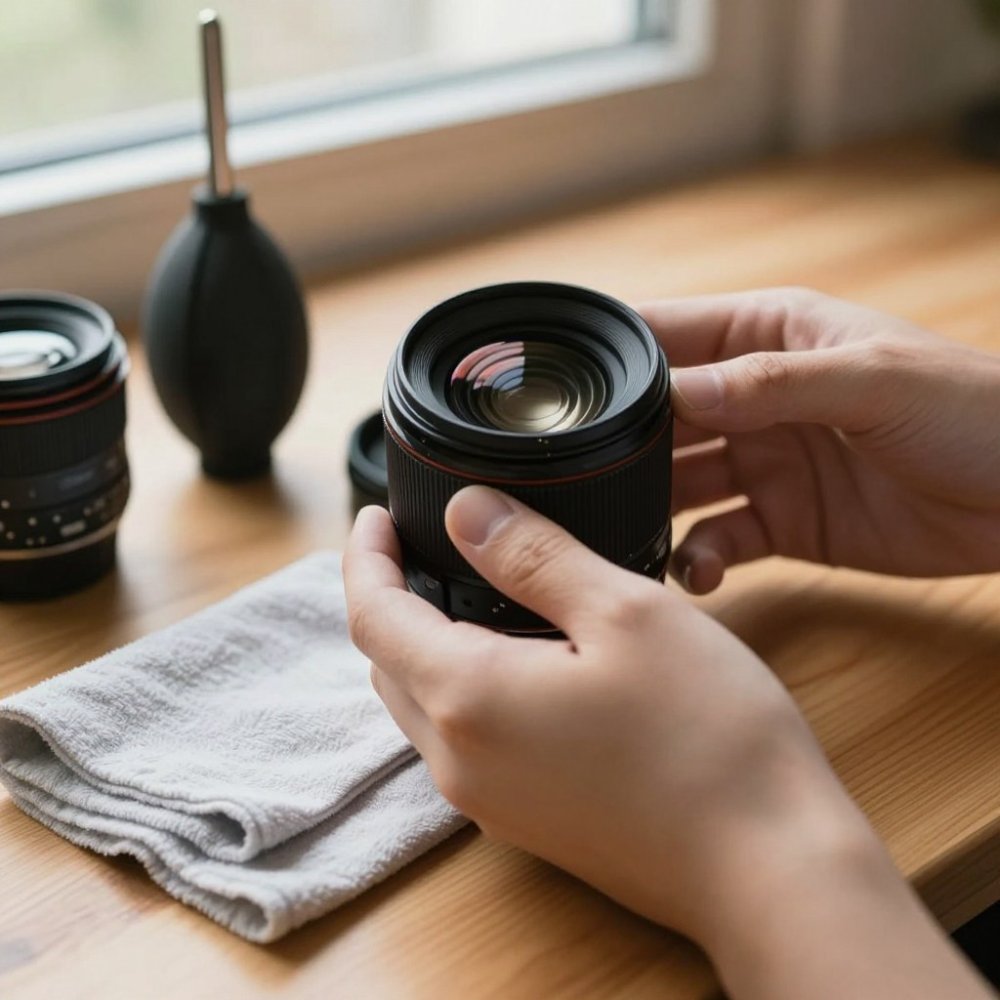
Used camera lenses for portraits are where the real savings live, but only if you inspect them properly. A budget prime bought secondhand can cost far less than new while delivering identical images, provided the glass and mechanics are sound.
Run this checklist before you pay:
- Shine a light through the glass: reject deep scratches, fungus or heavy haze
- Check both front and rear elements for cleaning marks
- Move the focus ring: it should turn smoothly with no grinding
- Test the aperture at every stop for sticky or oily blades
- Mount it and confirm autofocus locks quickly and quietly
- Ask for the serial number and check it matches the listing
- Confirm a return window exists before you commit
Our guide on what to look for in used lenses goes deeper on each step. If you are weighing where to buy, our comparison of KEH vs MPB for used camera gear covers the two main marketplaces for secondhand glass.
Buying a budget portrait lens is really a decision about how you shoot, not about how much you spend. The gear matters less than knowing your focal length, your aperture and how to spot a bad used copy.
That is the same principle behind Kameratalk: clear, practical guidance for people who love cameras. We help you compare gear, understand the specs that actually change your photos, and buy with confidence. Start for free and get straight answers on your next lens purchase.
Frequently Asked Questions
What is the best affordable lens for portrait photography?
A fast 50mm prime is the usual starting point. The Canon RF 50mm F1.8 STM is a common budget Canon RF portrait lens, and its f/1.8 aperture gives you shallow depth of field without a large outlay. If you shoot APS-C, the Sigma 56mm f/1.4 is a straightforward budget recommendation with an even wider maximum aperture. Check which mount your camera uses first, because the cheapest good lens is the one that actually fits your body.
Is a 50mm lens good for portrait photography?
Yes. A 50mm prime is flexible enough for half-body and environmental portraits, and on APS-C bodies it behaves like a short telephoto, which suits head-and-shoulders framing. The main trade-off is that at very close distances a 50mm can exaggerate facial features slightly, so step back and crop rather than filling the frame from 50 centimetres. The best 50mm lens for portraits is usually the fastest one your budget allows, since aperture matters more than the badge.
What aperture should I look for in a budget portrait lens?
Look for f/1.8 or wider as a baseline, because that is what separates your subject from the background. That said, the best aperture for portrait photography is rarely the widest one. Stopping down one or two stops, to around f/2.8 or f/4, sharpens the eyes and keeps both ears in focus. Use f/1.8 when the background is busy and you want it gone, and stop down when you need the whole face crisp.
Are used camera lenses for portraits a good option?
They can be, especially for students on a tight budget. A used 85mm f/1.8 or 50mm f/1.8 often costs a fraction of the new price and optically performs the same. Check the glass for scratches and haze, shine a light through the barrel, test the autofocus across the full range, and confirm the mount matches your body. Ask about the shutter count only for bodies, not lenses, and get the serial number in writing.
Can you take good portraits with a kit lens?
You can, with limits. A kit zoom usually tops out around f/3.5 to f/5.6, so you get less background blur and need more light. Shoot at the long end of the zoom, around 50mm to 55mm, place your subject well away from the background, and use window light. A kit lens teaches framing well. Once you know which focal length you reach for most, buy that prime and the difference in separation will be obvious.