Table of Contents
- KEH vs MPB for Used Camera Gear: What Actually Differs
- How the Two Marketplaces Operate
- Who Each One Suits
- KEH vs MPB for Selling Camera Gear
- MPB Used Camera Condition Ratings Explained
- How to Inspect a Used Camera Lens Before You Commit
- Price Comparison by Item and Condition
- Buyer vs Seller: Where Each Platform Wins
- Shipping, Returns and Transaction Safety
- Total Cost of Ownership and Gear Upgrades
- Frequently Asked Questions
Last Updated: October 12, 2026
KEH vs MPB for Used Camera Gear: What Actually Differs
Choosing between KEH and MPB for used camera gear comes down to one split: KEH is a US-based retailer with its own conservative grading scale, while MPB is a European marketplace platform built around peer-to-peer trade-ins. Both let you buy and sell used cameras, but they handle grading, payouts, and returns differently. This guide from Kameratalk walks through those differences so you can pick the right route for your budget and your gear.
Here is the part most comparison posts skip: the two platforms are not really the same kind of business. One is a traditional dealer that buys inventory outright and resells it. The other is a broker that connects your gear to a buyer and takes a cut. That single structural difference explains almost everything else, from how offers are calculated to how much room you have to negotiate.
Below, we break down buying, selling, grading, inspection, and total cost so you can decide with real numbers instead of vibes.
How the Two Marketplaces Operate
KEH operates as a classic dealer: it buys used photo equipment, grades it in-house, and resells it from its own inventory. That means you are always buying from KEH, not from another photographer, and the company stands behind the condition rating it assigns.
MPB works differently. It is a marketplace that lists your gear, matches it with a buyer, and handles the transaction and shipping. You are still dealing with MPB as the intermediary, but the item passes from seller to buyer rather than sitting in a warehouse.
For buyers, the practical effect is inventory and availability. A dealer model tends to have deeper stock of common camera bodies and lenses. A marketplace model depends on what sellers are currently listing, so availability shifts week to week.
The dealer-versus-marketplace split is the single most useful thing to understand. It tells you who owns the risk on grading and who controls the price.
Who Each One Suits
KEH suits buyers who want a fixed, professionally graded item and sellers who want a clean, hands-off sale. If you would rather not negotiate and you value a conservative grading standard you can trust, the dealer model is the simpler path.
MPB suits sellers who want to reach a broader pool of buyers and buyers who enjoy browsing a rotating catalog of peer-listed gear. It also tends to appeal to photographers trading up regularly, since listing and relisting gear is part of the workflow.
Here is how we would frame it for different priorities:
| Your priority | Better fit | Why |
|---|---|---|
| Predictable grading | KEH | In-house, conservative scale |
| Wide buyer reach when selling | MPB | Marketplace listing model |
| Deep stock of common bodies | KEH | Dealer inventory |
| Trading up often | MPB | Built around trade-ins |
KEH vs MPB for Selling Camera Gear
When selling, KEH gives you an outright quote and MPB lists your gear to buyers, so the payout mechanics differ. With KEH you get an offer, ship the item, and receive payment once it is checked in. With MPB, the platform facilitates the sale and you are paid after the buyer transaction completes.
The trade-off is speed versus reach. A dealer quote is usually faster and more certain because KEH is buying for its own inventory. A marketplace sale can net more if demand is strong, but it depends on a buyer showing up.
A common mistake is comparing a quote from one platform with a listing price on the other. Those are not the same number. A quote is what a dealer will pay you today. A listing price is what a hopeful seller is asking, before fees and before anyone actually buys.
Quotes, Payouts and Offer Adjustments
Offer adjustments happen on both platforms when the gear arrives in worse condition than described. This is the single biggest source of seller frustration, and it is avoidable.
Photograph every angle, note every scratch, and disclose shutter count on digital bodies. If your description is accurate, an adjustment is far less likely. If it is vague, expect the offer to move once the item is inspected.
Under-describing condition to get a higher initial quote backfires. The offer gets adjusted down after inspection, and you have already paid to ship the item.
MPB Used Camera Condition Ratings Explained
MPB used camera condition ratings describe cosmetic and functional state in plain tiers, from like-new down to well-used. The exact labels matter less than the principle: each tier reflects visible wear and whether the item is fully working.
In practice, a „like new“ rating should mean no meaningful marks and everything functioning. A mid-tier rating means normal cosmetic wear but full function. A lower tier means obvious wear, possibly minor issues, sold at a discount.
The key question for buyers is whether the rating covers optics and mechanics, not just the body. Scratches on a lens element affect images; scuffs on a body usually do not.
How KEH Grades Differ
KEH uses its own conservative grading scale, and the reputation for under-promising is the point. Many buyers report that KEH items arrive in better condition than the grade suggests, which is the opposite of what you want when selling and exactly what you want when buying.
That conservatism cuts both ways. As a seller, a strict grade can feel like a lowball. As a buyer, it is a feature, because the risk of a nasty surprise drops.
If you are coming from a marketplace where sellers self-grade optimistically, expect KEH’s labels to read one notch harsher for the same physical item.
How to Inspect a Used Camera Lens Before You Commit
Inspecting a used camera lens means checking glass, aperture, focus, and mount in that order, with a torch and a test shot. Do this before you commit, whether you are buying in person or validating an item on arrival.
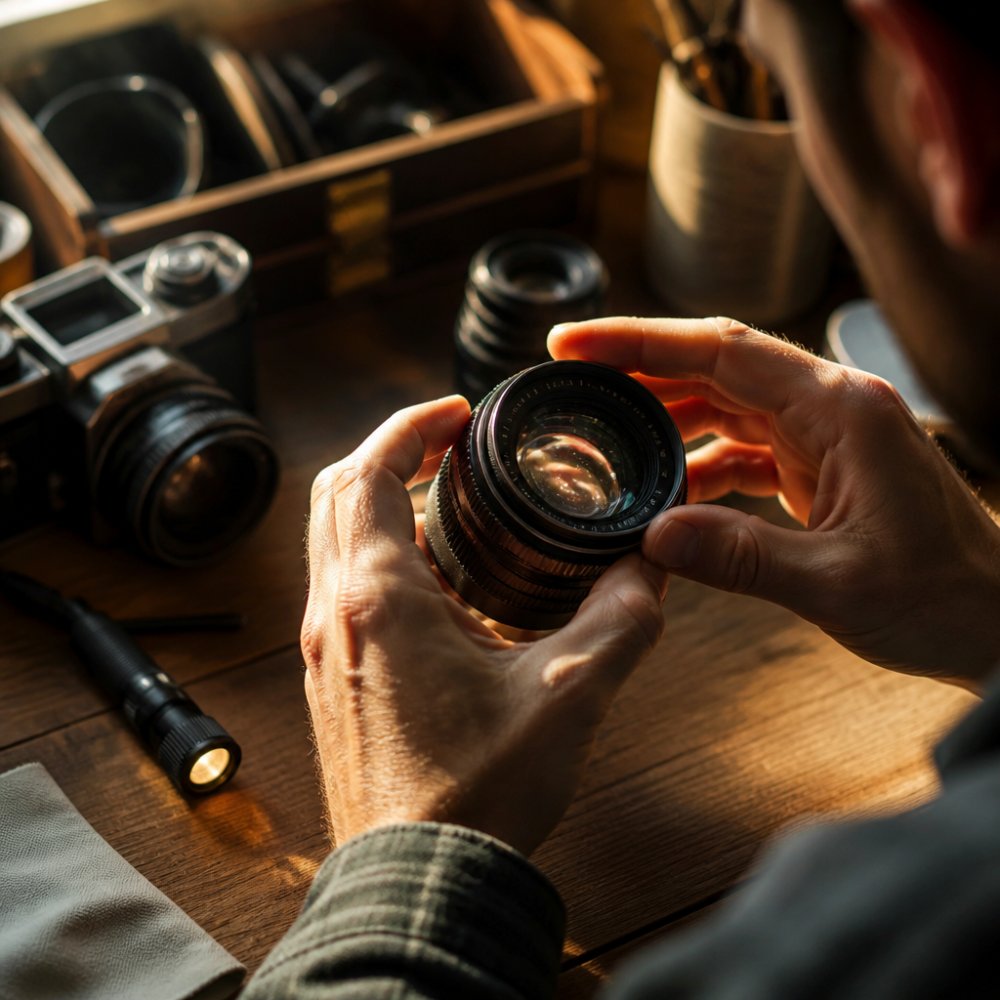
Start with the glass. Shine a torch through the front and rear elements at an angle. Dust is normal and often harmless. Scratches, haze, fungus, and separation are not, and they are hard to fix cheaply.
Then check the aperture blades for oil and the focus ring for smooth travel. Finally, mount the lens and take a test shot wide open to confirm sharpness and that autofocus locks.
Checklist for Camera Bodies and Vintage Gear
- Shutter count on digital bodies, if the seller will share it
- Sensor for dust, scratches, and dead pixels
- Viewfinder and screen for cracks or delamination
- All dials, buttons, and ports functioning
- Battery compartment free of corrosion
- For vintage gear: light seals, film advance, and meter accuracy
Price Comparison by Item and Condition
A fair price comparison between a dealer quote and a marketplace listing requires matching four variables: model, cosmetic grade, functional condition, and included accessories. Miss any one of them and the two numbers are not comparable, no matter how close they look on a spreadsheet.
Here is a repeatable method you can run on any body or lens in about ten minutes.
The four-variable match
- Model and variant. A camera body and its successor are not the same item. Neither is a lens in its original mount versus a later version with different coatings or autofocus motors. Match the exact model designation before you compare anything else.
- Cosmetic grade. Translate both platforms onto a single scale before comparing. A dealer’s conservative grade and a marketplace seller’s optimistic grade can describe the same physical item two tiers apart.
- Functional condition. Shutter count on digital bodies, fungus or haze on lens elements, and whether autofocus and stabilisation actually work. A body that powers on but has a tired shutter is not the same item as a low-count example.
- Included accessories. Original box, charger, battery, strap, caps, hood, and any paperwork. Accessories routinely shift a used price by a meaningful margin, and a quote that assumes ‚body only‘ is not comparable to a listing that includes the full kit.
Worked example: how to run the comparison
Pick a common full-frame mirrorless body and a common prime lens. For each, write down the four variables above for the dealer quote and for the marketplace listing. Then normalise:
- If the dealer quote is for a lower grade than the marketplace listing, adjust the marketplace figure down one tier before comparing.
- If the listing includes a box and charger that the quote assumes are absent, note that as a value add rather than a price difference.
- If the listing has no stated shutter count, treat it as unknown and weight the comparison accordingly.
What you will usually find is that the headline gap between a dealer payout and a marketplace listing shrinks considerably once the four variables line up. The remaining difference is the platform’s fee for carrying risk, handling logistics, and standing behind the grade.
What actually moves the number
| Variable | Effect on a dealer quote | Effect on a marketplace listing |
|---|---|---|
| Cosmetic grade one tier lower | Quote drops a step | Listing may sit unsold |
| High shutter count disclosed | Quote adjusts down | Buyers negotiate or pass |
| Original box and accessories | Small uplift | Noticeable uplift |
| Fungus or haze on glass | Quote drops sharply or declined | Listing attracts low offers only |
| Missing battery or charger | Quote adjusts down | Buyers factor replacement cost |
Run the four-variable match before you decide. A dealer payout that looks lower than a marketplace listing often closes most of the gap once grade, shutter count, and accessories are normalised, and the dealer number is the one you actually receive.
Why the two numbers are structurally different
A dealer is buying inventory to resell, so the quote already discounts for re-grading, storage, and the risk that the item sits. A marketplace listing is an asking price set by a seller who has not yet found a buyer, and it does not include the platform’s commission or the time the item may spend unsold. Comparing a payout to an asking price is the single most common error in these comparisons.
For buyers, the same logic runs in reverse. A dealer price is firm and tied to a stated grade. A marketplace price is negotiable but only as honest as the listing photos and description. If you want a predictable number, the dealer side is easier to budget against. If you want to hunt for a specific lens at a specific grade, the marketplace side gives you more shots on goal.
current used price guides for popular camera bodies and lenses
A quick sanity check before you commit
Before you accept a quote or click buy, ask three questions: Is the grade on the same scale on both sides? Is the shutter count or optical condition disclosed? Are the accessories the same? If any answer is no, the comparison is not finished.
Buyer vs Seller: Where Each Platform Wins
The right platform depends on which side of the transaction you are on and what you value most: certainty, selection, speed, or upside. Most comparisons blur buying and selling into one verdict. Separating them makes the choice much clearer.
If you are buying
| Your priority | Better fit | Why |
|---|---|---|
| Predictable condition | Dealer model | In-house grading on a conservative scale |
| Deep stock of common bodies and lenses | Dealer model | Inventory held and restocked continuously |
| Hunting a specific vintage or film item | Marketplace model | Rotating peer listings surface rare gear |
| Negotiating on price | Marketplace model | Asking prices are set by sellers |
| Fast, low-friction checkout | Dealer model | Firm price, stated grade, no back-and-forth |
For buyers, the dealer model reduces the risk of a nasty surprise because the grade is assigned by the seller of record, not by the person offloading the item. The marketplace model gives you more variety and more chances to find an unusual lens or a film body, but you carry more of the inspection burden yourself.
If you are selling
| Your priority | Better fit | Why |
|---|---|---|
| Money soon with minimal effort | Dealer model | Outright quote, you ship, you get paid |
| Maximum upside on desirable gear | Marketplace model | Listing can reach a wider pool of buyers |
| Avoiding negotiation | Dealer model | One offer, one decision |
| Trading up regularly | Marketplace model | Built around listing and relisting |
| Certainty of payout | Dealer model | Quote is agreed before you ship |
For sellers, the dealer model trades upside for speed and certainty. You know the number before the item leaves your hands, and you do not wait for a buyer to appear. The marketplace model can return more on gear that is in demand, but you absorb the wait, the listing effort, and the risk that the item does not sell at your asking price.
Decision framework by gear type
- Modern digital bodies and current-mount lenses. Both platforms handle these well. If you want speed, the dealer route is simpler. If you want to squeeze out more on a popular model, list it.
- Film bodies and vintage lenses. Marketplace listings tend to surface these to a wider audience of enthusiasts, but condition disclosure matters more because grading standards vary. Inspect carefully or buy from a source that grades conservatively.
- Specialist or niche optics. A marketplace with rotating inventory is often the only place a specific item appears. Expect to wait and to check listings regularly.
- Entry-level kits and bundles. Dealer quotes are usually straightforward, and the convenience of a single transaction often outweighs the small upside of listing.
The one question that decides it
Ask yourself whether you value certainty or upside more. If certainty wins, the dealer route is the better fit for both buying and selling. If upside wins and you can wait, the marketplace route gives you more room, provided you describe condition accurately and price realistically.
Buyers who hate surprises lean dealer. Buyers who enjoy the hunt lean marketplace. Sellers who want the money now lean dealer. Sellers who can wait for the right buyer lean marketplace.
A note on trading up
If your goal is to move from one body or lens to another, the loop matters as much as the individual transaction. A fast, certain payout makes it easier to fund the next purchase on a schedule. A higher-upside sale rewards patience but delays the upgrade. Match the platform to how quickly you want to be shooting with the new gear.
Shipping, Returns and Transaction Safety
Shipping, returns, and transaction safety come down to who holds the risk during transit and after delivery. On both platforms, the intermediary handles the logistics, which is a genuine advantage over a random classifieds meetup.
A dealer model typically inspects items on arrival and can adjust the offer, so the seller carries some risk until check-in completes. A marketplace model routes the item from seller to buyer, and the platform mediates if something goes wrong.
For buyers, the important question is the return window. Confirm it before you buy, in writing, and check whether return shipping is covered. That single detail matters more than most spec sheets.
Total Cost of Ownership and Gear Upgrades
Total cost of ownership for used camera gear is the purchase price plus the cost of the next upgrade, minus what you recover when you sell. Photographers who ignore that last term consistently overpay over a few years.
Buying used and selling before the model loses too much value keeps the real cost of a body or lens lower than buying new. The platform you choose affects that loop: fast, certain payouts make it easier to trade up on a schedule, while higher-upside sales reward patience.
Our advice is to treat gear as a rotating position, not a permanent purchase. Buy used, keep it in good condition, and sell while demand is still strong. The grading transparency you get from a conservative dealer helps here, because an accurate grade protects your resale value later.
Frequently Asked Questions
Is KEH or MPB better for buying used camera gear?
Both are established specialist retailers for used camera gear, but they suit different buyers. KEH is known for a wide inventory of camera bodies and lenses, including older film and vintage equipment, with conservative condition grading. MPB focuses on modern digital gear with detailed item-specific photos of the actual unit you receive. If you want a specific older lens or film camera, KEH often has more choice. If you want to see the exact camera body you are buying before it ships, MPB’s photo-per-item approach is more transparent.
How do KEH and MPB grade used camera gear?
MPB uses a tiered condition rating system, from Like New down through Excellent, Good and Well Used, with each tier describing cosmetic wear and functional state. KEH uses its own letter-based grades, such as Like New, Excellent Plus, Excellent, Bargain and Ugly, and is generally regarded as grading conservatively, so a Bargain item often arrives in better shape than the label suggests. Always read the specific grade definitions on each site before you buy, because the wording differs and a direct one-to-one mapping is not exact.
Which is better for selling used camera gear, KEH or MPB?
It depends on how much effort you want to invest. Both offer an online quote based on your description of the item, then adjust the final offer after inspection if the condition differs. MPB tends to be popular with sellers of modern digital gear, while KEH handles film and vintage equipment well. For either platform, photograph your item thoroughly, describe flaws honestly, and keep the original box and accessories, because that reduces the risk of an offer adjustment and speeds up the payout.
What should you check before buying a used camera or lens online?
Ask for or review item-specific photos, then check the glass for scratches, haze, fungus and separation, and the barrel for dents or stiff focus rings. For camera bodies, verify the shutter count, test all dials and ports, and confirm the sensor is free of scratches. Check the seller’s return window and warranty terms, and confirm the item matches the condition grade described. Buying from a specialist retailer with a clear returns policy is safer than a private marketplace listing with no recourse.
The hard part of buying and selling used camera gear is not the gear itself, it is trusting the grade and the payout. Kameratalk is built for exactly that, with a free plan to get you started and a community that treats analog and digital equipment as something worth passing on carefully. Start for free with Kameratalk and keep your next upgrade simple, secure, and efficient.