Last Updated: October 27, 2026
Quick Summary
Camera sensor size is the physical area of the light-sensitive chip inside a camera, measured diagonally in millimetres. A larger sensor gathers more light, which means cleaner low-light files, a wider field of view at the same focal length, and shallower depth of field. Common formats run from smartphone and 1-inch sensors up through Micro Four Thirds, APS-C, full frame, and medium format.
- Full frame measures about 36 x 24 mm, APS-C around 23.5 x 15.6 mm, and Micro Four Thirds 17.3 x 13 mm.
- A full-frame sensor has roughly 2.3 times the light-gathering area of APS-C.
- Crop factor is about 1.5 on APS-C and 2.0 on Micro Four Thirds for full-frame equivalent framing.
- The „1-inch type“ label is a historical naming convention, not the chip’s actual measurement.
- Set a total budget for body plus two lenses before comparing formats.
Table of Contents
- What Camera Sensor Size Means and Why It Matters
- How Sensor Size Is Measured
- Common Sensor Formats and Their Dimensions
- Full Frame vs APS-C: The Decision Most Beginners Face
- Crop Factor Explained Without the Maths Headache
- How Sensor Size Affects Field of View and Framing
- How Sensor Size Affects Image Quality and Low-Light Performance
- Sensor Size vs Resolution: Which Number Actually Matters
- How Sensor Size Affects Depth of Field and Background Blur
- Camera Sensor Size and Lens Compatibility
- Separating Sensor Size from Lens, Exposure and Processing
- Sensor Size in Video: Crop Modes and Readout
- Matching Sensor Size to Your Photography: A Beginner Checklist
- Frequently Asked Questions
What Camera Sensor Size Means and Why It Matters
Camera sensor size is the physical area of the light-sensitive chip inside a camera body, measured diagonally in millimetres. It is the single specification that shapes how much light a camera can gather, how much of a scene fits in the frame, and how much background blur you can create. A larger sensor captures more light across a wider area, which is why a full-frame body behaves so differently from a compact or a phone. Below are the formats and trade-offs to consider when choosing a size that matches what you actually shoot.
The Window and Bucket Analogy
Think of the sensor as a window and each pixel as a bucket sitting under it. A bigger window lets in more total light, so the buckets fill faster and with less noise. A smaller window still works, but you have to leave it open longer or push the sensitivity higher, and that is where grain creeps in. The analogy is not perfect, but it gets you 90% of the way there: more sensor area means more light gathered, and more light gathered means cleaner files in dim conditions. Field of view works like the window frame too. A bigger frame shows more of the scene at the same lens setting.
How Sensor Size Is Measured
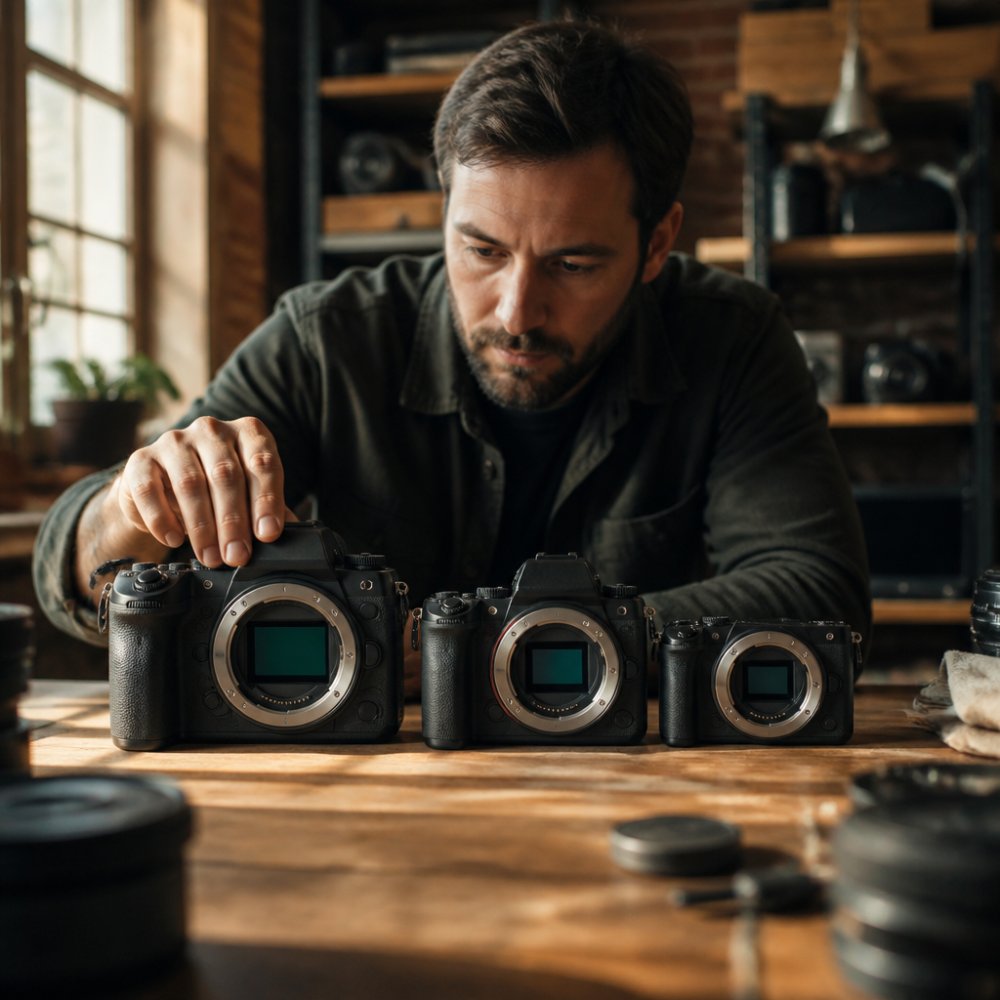
Sensor size is measured as the diagonal distance across the rectangular chip, expressed in millimetres, and it is usually quoted alongside the width and height. A full-frame sensor measures roughly 36 x 24 mm with a diagonal near 43 mm. An APS-C chip is around 23.5 x 15.6 mm. Micro Four Thirds sits at 17.3 x 13 mm. Those three numbers tell you almost everything about how a camera will behave before you ever pick it up.
Manufacturers quote the diagonal because it lets you compare formats directly, even when the aspect ratio differs. A 4:3 chip and a 3:2 chip with the same diagonal capture a similar amount of the scene, just shaped differently. When you are inspecting a used body, it pays to know how to check a camera sensor for damage before you commit, since the physical dimensions tell you nothing about scratches, dust, or dead pixels on the surface.
Common Sensor Formats and Their Dimensions
Here is the chart most beginner guides skip. Actual dimensions, consistent units, no marketing spin:
| Format | Approx. dimensions (mm) | Diagonal (mm) | Typical cameras | Best for |
|---|---|---|---|---|
| Medium format | 43.8 x 32.9 | ~55 | High-end studio bodies | Landscapes, studio, large prints |
| Full frame | 36 x 24 | ~43 | Pro and enthusiast mirrorless | Low light, portraits, wide scenes |
| APS-C | 23.5 x 15.6 | ~28 | Enthusiast and student bodies | All-round, travel, wildlife reach |
| Micro Four Thirds | 17.3 x 13 | ~21.6 | Compact system cameras | Portability, video, street |
| 1-inch type | 13.2 x 8.8 | ~15.9 | Premium compacts | Travel, everyday carry |
| Smartphone | ~9.8 x 7.3 | ~12 | Phones | Always with you, quick sharing |
The Misleading Inch-Type Convention
The „1-inch type“ label is a historical leftover from video tube naming and does not describe the sensor’s actual size. A so-called 1-inch sensor measures about 13.2 x 8.8 mm, nowhere near 25.4 mm. The number refers to the outer diameter of a glass tube that once housed the imaging surface, not the chip itself. Treat inch-type labels as a category name, not a measurement. When a spec sheet says „1/2.3-inch“ or „1-inch,“ convert it to millimetres before you compare anything, or you will draw the wrong conclusion about which camera gathers more light.
Full Frame vs APS-C: The Decision Most Beginners Face
For most beginners, the full frame vs APS-C choice comes down to light gathering and background blur versus cost, weight, and reach. Full frame gives you a larger sensor area, cleaner high-ISO files, and shallower depth of field at the same aperture. APS-C gives you a smaller, lighter body, cheaper lenses, and extra reach from every telephoto because of the crop factor. Neither is „better.“ They solve different problems.
The numbers make the trade-off concrete. A full-frame sensor is roughly 36 x 24 mm (about 864 mm²), while an APS-C chip is around 23.5 x 15.6 mm (about 367 mm²). That is roughly 2.3 times the light-gathering area, which is why full frame pulls ahead in dim conditions. But that advantage only shows up when you compare like for like: same framing, same shutter speed, same output size.
Here is the matched comparison most guides skip. To get the same field of view and the same depth of field on APS-C as a 50 mm f/1.8 on full frame, you need roughly a 35 mm f/1.2 lens. That lens is heavier, rarer, and more expensive than the full-frame 50 mm f/1.8. The reverse is also true: a 35 mm f/1.4 on APS-C behaves like a 52 mm f/2.1 on full frame, which is a perfectly usable portrait setup. The sensor does not create the look on its own, the lens and the aperture you can afford do.
If you shoot mostly in daylight, travel a lot, or want reach for wildlife, APS-C may suit your needs. For concrete camera recommendations that fit your budget and skill level, see our guide to the best mirrorless camera for photography students. If you shoot events, portraits, or interiors in poor light and want that smooth background separation, full frame may suit your needs.
Full frame buys you roughly one stop of low-light performance and easier background blur at the same aperture. APS-C buys you lighter gear, cheaper glass, and more reach. Decide which of those you will actually use, not which sounds more professional.
Crop Factor Explained Without the Maths Headache
Crop factor is the number you multiply a lens’s focal length by to find its full-frame equivalent field of view. An APS-C camera has a crop factor of about 1.5 (1.6 on some bodies), and Micro Four Thirds sits at 2.0. So a 50 mm lens on APS-C frames like a 75 mm lens on full frame. That is the whole idea. You are not changing the lens, just the slice of the image circle the sensor sees.
Why does it matter? Two reasons. First, it tells you what a lens will actually frame before you buy it. Second, it explains the reach advantage: a 200 mm lens on Micro Four Thirds frames like 400 mm on full frame, which is why bird and wildlife shooters love smaller sensors. The trade-off is at the wide end, where crop sensors struggle to go as wide as full frame without specialist glass. Multiply, then decide.
How Sensor Size Affects Field of View and Framing
A larger sensor captures a wider field of view at the same focal length, because it takes in more of the image circle the lens projects. Put a 35 mm lens on full frame and you get a wide, environmental shot. Put the same lens on APS-C and the framing tightens to roughly a 52 mm equivalent, closer to a standard view. This is the crop factor in action, and it changes how you compose far more than most beginners expect.
The practical upshot: on a crop sensor, your wide lenses feel less wide and your telephotos feel longer. If you love sweeping landscapes, that is a real constraint. If you chase distant subjects, it is a gift. Framing is a conversation between sensor size and focal length, and once you internalise the crop factor, you stop being surprised by what you see through the viewfinder.
How Sensor Size Affects Image Quality and Low-Light Performance
A larger sensor generally produces cleaner images in low light because it gathers more total light and its individual pixels can be larger. More light gathered per pixel means a stronger signal relative to noise, so you can shoot at higher ISO settings without the image falling apart. Dynamic range tends to improve too, giving you more room to recover shadows and highlights in editing. That is the core reason full-frame bodies dominate event and available-light work.
But here is where most guides oversimplify. Sensor size is only one input. A newer APS-C sensor with modern processing can beat an older full-frame chip, and a fast lens on a small sensor often outperforms a slow lens on a big one in dim conditions. The sensor sets the ceiling; the lens and the processing decide how close you get to it. For a full picture of how sensor dimensions interact with the rest of the camera, DPReview’s technical explainers are a solid reference point. DPReview technical explainers
Sensor Size vs Resolution: Which Number Actually Matters
For most beginners, sensor size matters more than resolution. A 24-megapixel full-frame camera will typically produce cleaner low-light files and smoother tonality than a 24-megapixel phone sensor, because each pixel on the larger chip is physically bigger and collects more light. Resolution tells you how much detail you can record in good light. Sensor size tells you how well you record it when the light drops.
Pixel size, sometimes called pixel pitch, is the bridge between the two. Pack more megapixels onto a small sensor and each pixel shrinks, gathering less light. Pack the same megapixels onto a large sensor and each pixel stays roomy. That is why chasing megapixels on a tiny chip is a losing game. If you print large or crop heavily, resolution helps. Sensor area is another factor to consider.
How Sensor Size Affects Depth of Field and Background Blur
A larger sensor produces shallower depth of field at the same aperture and framing, which is why full-frame portraits show that creamy background blur so many beginners chase. The reason is magnification: to frame the same subject, you either stand closer or use a longer lens on the larger sensor, and both reduce depth of field. Bokeh, the quality of that blur, depends on the lens design, but the amount of blur leans on sensor size.
Here is the part people miss. You can match the look across formats by adjusting aperture and distance, but you cannot always match it cheaply. Getting full-frame separation on a crop sensor often means a faster, pricier lens. If background blur is central to your style, a larger sensor makes it easier. If you shoot landscapes or street scenes where everything should be sharp, the advantage shrinks to almost nothing.
Camera Sensor Size and Lens Compatibility
Camera sensor size and lens compatibility are tied together by the image circle, the cone of light a lens projects. A full-frame lens covers a full-frame sensor. Mount that same lens on an APS-C body and it works fine, you just use the centre portion. Mount an APS-C lens on a full-frame body and you either get heavy vignetting or the camera automatically crops to a smaller area. That is why the mount ecosystem matters as much as the sensor.
Before buying any used lens, check that it covers your sensor and that the mount matches your body. Our used lens buyer’s guide walks through what to inspect before you commit. The rule of thumb: bigger sensor, bigger image circle required. Buy glass that covers your format, and you will never fight dark corners.
Separating Sensor Size from Lens, Exposure and Processing
Sensor size gets blamed for a lot of things it does not control. A soft image can involve the lens as well as other factors. A noisy shot can be underexposed, and lifting it in editing can amplify the grain. Flat colours can involve processing as well as other factors. Before you conclude that your sensor is holding you back, rule out the lens, the exposure, and the editing pipeline.
This matters because a better lens or a corrected exposure may address some problems without upgrading the camera body. The sensor sets the physical limits. Everything else in the chain decides whether you reach them. Get the exposure right in camera, use a decent lens, and process with restraint, and even a modest sensor will surprise you.
Sensor Size in Video: Crop Modes and Readout
Sensor size affects video in ways that stills shooters do not expect. Many cameras offer crop modes that read only part of the sensor to enable higher frame rates or sharper 4K, which changes your field of view mid-shoot. A full-frame body shooting in a crop mode behaves like an APS-C camera, so your carefully planned wide shot suddenly tightens. Readout speed matters too: slower readout can cause rolling shutter, where fast pans look wobbly.
For video, the trade-off shifts. A smaller sensor with fast readout can be more practical for handheld work, while a larger sensor gives cleaner low light and more blur control. Check whether the camera’s 4K mode uses the full sensor width or crops, because that single detail changes which lenses you need. It is the spec sheet line most beginners skip and later regret.
Matching Sensor Size to Your Photography: A Beginner Checklist
Use this checklist to turn everything above into a decision. Work through it honestly, and the right format usually picks itself:
- What do you shoot most? Travel and street favour smaller sensors; portraits and events favour larger ones.
- How often is the light poor? Frequent low-light work pushes you toward full frame or a fast lens.
- Do you need reach? Wildlife and sports benefit from the crop factor of APS-C or Micro Four Thirds.
- How much weight will you carry? Smaller sensors mean lighter bodies and lenses you will actually take out.
- What is your realistic budget? Include lenses, not just the body, before you decide.
- Do you print large or crop hard? That is where resolution and sensor area both pay off.
- Buying used? Verify the shutter count on the body before you commit.
- New to the system? Budget for the essential accessories a new camera owner needs alongside the body.
Now translate the answers into a format. These are the patterns most beginners land on, with the reasoning behind each:
Travel and everyday carry. A 1-inch-type compact or a Micro Four Thirds body keeps the bag light and the sensor big enough for decent low light. If you want one body for everything, an APS-C kit with a 18-55 mm equivalent zoom covers more ground than a fixed-lens compact.
Portraits and people. APS-C with a fast 35 mm or 50 mm equivalent prime is the value sweet spot. Full frame makes the same look easier and cleaner in poor light, but only if you can afford a fast prime, the kit zoom will not deliver the blur you are chasing.
Wildlife and sports. APS-C or Micro Four Thirds stretch every telephoto. A 300 mm lens on Micro Four Thirds frames like 600 mm on full frame, which is why bird shooters often choose the smaller format and put the savings into glass.
Video and hybrid work. Check crop modes before you buy. A full-frame body that crops to APS-C for 4K behaves like a smaller sensor mid-shoot, so your wide lens tightens. A smaller sensor with fast readout can be more practical for handheld work.
Landscape and studio. Full frame or medium format give you more room to crop and cleaner shadow recovery, but the gain only matters if you print large or push files hard in editing.
Set a total budget for body plus two lenses before you compare formats. A body paired with a suitable lens can be a useful combination, regardless of sensor size.
If you are still torn between two formats, consider handling cameras in person before you buy. And remember the throughline of this whole guide: sensor size shapes the ceiling, but your lens, exposure, and processing decide how close you get to it. Pick the format that fits how you actually shoot, not the one with the biggest number on the box.
Frequently Asked Questions
What does camera sensor size mean?
Camera sensor size is the physical area of the light-sensitive chip inside a camera that records the image. It is measured as width by height in millimetres, plus a diagonal figure. A full-frame sensor measures roughly 36 x 24 mm, an APS-C sensor around 23.5 x 15.6 mm, and a Micro Four Thirds sensor about 17.3 x 13 mm. That physical area decides how much light the camera collects, how wide the field of view is with a given lens, and how shallow you can make depth of field.
Is a full-frame sensor better than APS-C?
Full frame vs APS-C is not a simple better-or-worse question. A full-frame sensor gathers more total light, which usually means cleaner files in dim conditions and shallower background blur. But APS-C bodies and lenses can be smaller and lighter, and the extra reach from the crop factor can suit wildlife and travel. Many beginners shoot for years on APS-C without hitting its limits. Choose full frame when low light and shallow depth of field are central to what you shoot, not because it is the bigger number.
Does a larger camera sensor perform better in low light?
A larger sensor collects more light at the same aperture and shutter speed, so at matched output size it usually shows less noise. The gap narrows once you account for lens aperture: a fast lens on a smaller sensor can close much of it. Processing also matters, since modern noise reduction changes results noticeably. Compare real files from cameras you are considering rather than assuming the larger sensor always wins in dim rooms or at dusk.
Does sensor size change a lens’s focal length?
The focal length printed on a lens never changes; it is a property of the glass. What changes is the field of view you get from it. Crop factor explained in one line: multiply the focal length by the sensor’s crop factor to find the equivalent full-frame focal length. A 50 mm lens on APS-C (1.5x) frames like a 75 mm lens on full frame. That is why the same lens feels tighter on a smaller sensor.
What is the difference between APS-C and Micro Four Thirds?
APS-C is larger, roughly 23.5 x 15.6 mm with a 1.5x crop factor, while Micro Four Thirds measures about 17.3 x 13 mm with a 2x crop factor. Sensor size is one factor in low-light performance and depth of field. Body and lens size can also vary between camera systems, which may matter for travel and hiking. Both systems have deep lens ranges, so check the lenses you actually want before deciding on the format.
What camera sensor size is best for beginners?
For beginners, APS-C or Micro Four Thirds may be a practical starting point, depending on the camera and lenses being considered. A one-inch compact suits travel and everyday carry. Full frame makes sense if portraits with strong background blur or low-light work are your main interest and you accept the extra weight and cost. Match the sensor to what you shoot, then spend the difference on a better lens.