Last Updated: October 30, 2026
Quick Summary
Choosing in the adorama vs bhphotovideo comparison comes down to whether you want the bigger catalog and showroom floor or the smaller store that picks up the phone faster. Both are long-established camera stores selling new and used gear, and neither wins universally, so compare per item on landed cost, condition notes and return terms.
- Check the availability line on any listing before committing, especially on newly released bodies.
- Grading labels are not standardized, so read shutter count, cosmetic marks and included accessories in the notes.
- Compare the return window, used-gear exception and return-freight responsibility side by side before checkout.
- Get two trade-in quotes and check your shutter count first, since it directly affects valuation.
- Estimate landed cost as item price plus shipping plus import VAT on that subtotal plus duty plus return freight.
Table of Contents
- Adorama vs B&H Photo: What Actually Separates Them
- Product Selection and Inventory Availability
- Adorama vs B&H Used Gear: Condition Grading and Buyer Protections
- Camera Store Return Policy Comparison
- Camera Equipment Trade-In Options at Both Retailers
- Buying Used Camera Equipment Online: Shipping, Customs and Gray Market
- Total Purchase Cost: What the Sticker Price Leaves Out
- Customer Service, Showroom Experience and Hands-On Testing
- Matching the Retailer to Your Gear and Use Case
- Building Your Camera Kit With Kameratalk
- Frequently Asked Questions
Adorama vs B&H Photo: What Actually Separates Them
Choosing between the two stores in this adorama vs bhphotovideo comparison comes down to one question: do you want the bigger catalog and the showroom floor, or the smaller store that picks up the phone faster? Both are long-established camera stores, and both sell new and used gear. This guide from Kameratalk breaks down where each one wins.
Here’s the thing most comparisons get wrong. The two retailers are more alike than different on paper.
Below, we’ll walk through inventory, used gear, return policies, trade-ins, gray market risks, total cost, and service. You’ll finish knowing which retailer fits your next lens or body.
Product Selection and Inventory Availability
Availability matters as much as selection. Check the availability line on any retailer’s listing before you commit, especially on newly released bodies.
Adorama vs B&H Used Gear: Condition Grading and Buyer Protections
The Adorama vs B&H used gear comparison is where the two diverge most. Both grade used items on a scale from like-new down to well-used, and both inspect equipment before listing. Adorama tends to publish more detail in its condition notes, while B&H’s grading is consistent but sometimes terse.
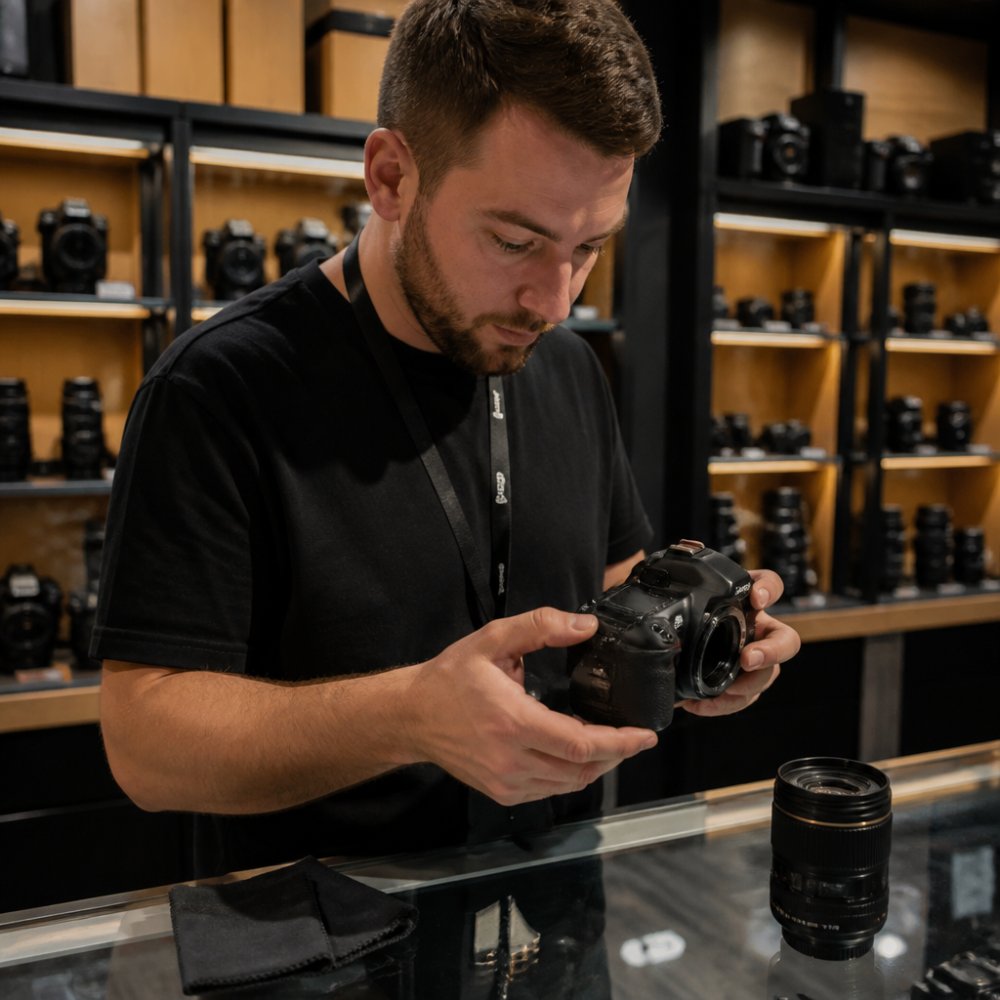
What most guides miss is that grading labels are not standardized across the industry. A „9+“ at one store may equal an „excellent“ at another. Read the specific notes: shutter count, cosmetic marks, included accessories, and whether the original box is present.
Before buying used camera gear, run a proper inspection routine. Our guide on how to inspect a used camera sensor walks through the checks that catch the problems grading labels miss. If you’re weighing dedicated used marketplaces against these two, our KEH vs MPB comparison covers that angle. And for glass specifically, what to look for in used lenses explains the mechanical and optical checks that matter.
Watch out: never trust a condition label alone. Ask for the shutter count in writing before you pay.
Camera Store Return Policy Comparison
A camera store return policy comparison is where most guides stay vague, so here is the concrete version. When comparing camera store return policies, the key points to check are the return window, the used-gear exception, and who pays return freight, and how German consumer-protection rules interact with a cross-border purchase.
Start with the window itself. Confirm the exact return window on any retailer’s site before ordering, because terms change and the listing page is the authoritative source. Read the return terms on the product page for used and special-order items, not only the general policy page.
For buyers in Germany, the return path has an extra layer. A cross-border return means you are shipping back to the retailer’s origin, and the return freight can exceed the value of a small accessory. Before you order, check who pays return shipping and whether the retailer provides a prepaid label or expects you to arrange carriage. On a high-value body, photograph the item and the packaging before you open it fully, that record is what protects you if a return is disputed.
German statutory withdrawal rights for distance sales do not automatically map onto a retailer’s own return policy, and cross-border returns can involve freight costs that erase the benefit. Confirm the retailer’s terms and your rights before ordering high-value gear.
The practical takeaway: compare the return window, the used-gear exception, and the return-freight responsibility side by side before checkout. A generous window means little if you are covering international shipping both ways.
Camera Equipment Trade-In Options at Both Retailers
Get two quotes before you commit, and check your shutter count first. Our guide on how to check shutter count shows where to find it on major brands, which directly affects your valuation.
A fair offer depends on honesty about condition. Disclose scratches, dust, and any repair history upfront. Undisclosed issues get discovered on inspection and cut the final payout.
Buying Used Camera Equipment Online: Shipping, Customs and Gray Market
Buying used camera equipment online often involves cross-border shipping. Check whether import duties and value-added tax apply on arrival, and budget for them before checkout.
Gray market is the bigger risk. A non-US version of a body or lens may lack a local manufacturer warranty, and service centers can refuse repairs. If the price looks unusually low, check the warranty line.
Our broader guide to buying used cameras from online portals covers how to spot gray market listings and what protections to expect. For cross-border buyers, confirm the warranty is valid in your region before you pay.
Total Purchase Cost: What the Sticker Price Leaves Out
When comparing camera retailers, the sticker price is not the total purchase cost, and for a cross-border order the gap can be large. The components are shipping and handling, import value-added tax, any customs duty, and the cost of return freight if something goes wrong. On a used body, add a possible service or sensor clean. The table below shows what to check for each.
| Cost Component | What to Check | Why It Matters |
|---|---|---|
| Item price | Listed price vs. sale price | Base figure only |
| Shipping and handling | Carrier, speed, tracking | Can swing widely |
| Import VAT | The rate applied on import | Often the largest add-on |
| Customs duty | Whether the item category is dutiable | Can apply on top of VAT |
| Return freight | Who pays, both directions | Eats into savings |
| Service or clean | Used gear condition | Hidden ownership cost |
Here is the mechanism most guides skip. When gear is imported into Germany, import VAT is charged on the customs value plus the shipping cost, and customs duty, where it applies, is calculated on the same base. That means shipping is not a separate line you can ignore: a higher shipping charge raises the VAT and duty you pay. The listed price on the retailer’s site is therefore only the starting point, and the landed cost is what you should compare.
A simple way to estimate landed cost: take the item price, add shipping, apply the import VAT rate to that subtotal, add any duty, and add return-freight exposure. Compare two listings on that number rather than on the sticker price, and the cheaper option sometimes flips. On a used body, factor in a sensor clean or service as part of ownership cost.
Build a landed-cost estimate before checkout: item price + shipping + import VAT on the combined subtotal + any duty + return-freight exposure. Compare retailers on that total, not on the listed price.
A common mistake is comparing two listings on price alone. Compare total landed cost instead, and budget for the add-ons before you pay.
Customer Service, Showroom Experience and Hands-On Testing
Hands-on testing matters most for ergonomics and autofocus. Specs don’t tell you how a body feels in your hand after an hour. If you can visit a showroom, do it before committing to a system.
Matching the Retailer to Your Gear and Use Case
Match the retailer to what you’re buying. For a niche accessory or a specific new lens, compare catalog depth. For a used body where condition detail matters, compare grading notes. For trade-ins, get multiple quotes.
Here’s a simple decision path:
- Need a hard-to-find part fast? Go with the broader catalog.
- Buying used glass? Read condition notes on both, then decide.
- Trading in a body? Compare two quotes against shutter count.
- Shipping abroad? Calculate landed cost before checkout.
There’s no universal winner. The right camera store depends on the specific purchase, and the honest answer is to compare per item.
Building Your Camera Kit With Kameratalk
Building a camera kit is easier when you know what to check before you buy, and that’s what we focus on at Kameratalk. We cover camera gear, stores and community topics, including used-gear checks, so you can evaluate listings with confidence.
Kameratalk covers analog and digital camera equipment with an eye on affordability for students and hobbyists. Whether you’re comparing retailers or inspecting a used lens, the goal is the same: buy once, buy right.
Start for free with Kameratalk and get the buyer guides and gear advice that help make your next purchase a confident one.
Frequently Asked Questions
Is Adorama or B&H Photo better for buying camera equipment?
Neither wins outright. For a buyer outside the US, the deciding factors are usually shipping and handling cost, delivery estimate, and how the return window works once the parcel crosses customs. Compare the total purchase cost for the exact item you want rather than the listed price alone.
Are Adorama and B&H Photo trustworthy retailers?
Both are established New York camera stores with long reputations and large customer ratings bases, so trustworthiness is not the main worry. The practical risk for a European buyer is the non-US version: bodies and chargers sold for another market may lack local warranty coverage. Check the manufacturer warranty terms and the return policy before ordering, and confirm the item is not a gray market import.
How do Adorama and B&H Photo compare for used camera gear?
Adorama vs B&H used gear comes down to condition grading and inspection detail. Both publish a grading scale and inspect equipment before resale, but the descriptions differ in how much cosmetic wear they flag. Read the specific grade notes and photos for each listing, and ask about shutter count on used bodies. A fair offer on trade-in also depends on how complete the kit is: box, caps, charger and original receipt all raise resale value.
Can you trade in used camera equipment at Adorama or B&H Photo?
Expect the quote to shift after inspection if condition differs from your description.