Last Updated: November 24, 2026
Quick Summary
A used camera is sold in whatever condition the previous owner left it, while a refurbished camera has been returned, inspected, and brought back to working order by a seller who backs it with a warranty. Most buyers should decide based on how much risk they can stomach, not just the sticker price.
- A private used camera sale typically carries more risk for the buyer than a refurbished purchase.
- Manufacturer refurbished units follow a documented process and come with the strongest warranty terms.
- Inspect a used camera in about twenty minutes: battery, sensor, mount, dials, seals, then lens.
- Ask the seller for a shutter-count screenshot with the serial number visible before you meet.
- If you can’t inspect the camera in person, pay for the warranty and buy refurbished.
Table of Contents
- What Separates a Used Camera From a Refurbished One
- How to Inspect a Used Camera Before You Hand Over Money
- What Refurbished Camera Condition Grades Actually Tell You
- Used Camera Shutter Count and What It Means for Lifespan
- Refurbished Camera Warranty and Return Windows by Seller Type
- Price, Savings and Total Cost of Ownership
- Reliability, Defects and the Real Risk of Each Option
- Pros and Cons Side by Side
- Which Buyer and Use Case Fits Which Camera
- Build Your Shortlist With Kameratalk
- Frequently Asked Questions
What Separates a Used Camera From a Refurbished One
A used camera is sold in whatever condition the previous owner left it. A refurbished camera has been returned, inspected, and brought back to working order by a seller who then backs it with a warranty. That single difference, who takes responsibility after the sale, matters more than the label on the listing.
Many first-time buyers assume „refurbished“ is just a fancy word for „used.“ It isn’t. The two categories carry different risks and different paperwork. Below, we’ll break down exactly how to tell them apart, how to inspect a used camera before money changes hands, and which option fits your budget and your nerves.
Here’s the short version: a private used camera sale typically carries more risk for the buyer. A refurbished camera usually shifts much of that risk onto the seller, depending on the seller’s terms. Most buyers should decide based on how much risk they can stomach, not just the sticker price.
Definitions: second-hand, pre-owned and manufacturer refurbished
Second-hand and pre-owned mean the same thing: the camera had an owner before you. Condition is whatever it is, and the seller may be a private individual or a shop.
Manufacturer refurbished means the maker’s own service arm checked and repaired the camera, then sells it with a warranty. Seller refurbished means a dealer did that work instead. The quality of seller refurbishment varies widely, which is why the warranty terms matter so much.
That distinction is your first filter. Manufacturer refurbished units follow a documented process. A private listing with the word „refurbished“ in the title often means nothing at all.
How to Inspect a Used Camera Before You Hand Over Money
The best way to inspect a used camera is to test it in person, in this order: battery and accessories, sensor, mount, dials, seals, then the lens. Skip the cosmetic small talk and go straight to the parts that cost the most to repair. The checklist below is built so you can run it in about twenty minutes and walk away with a pass or fail on each item, not a vague feeling.
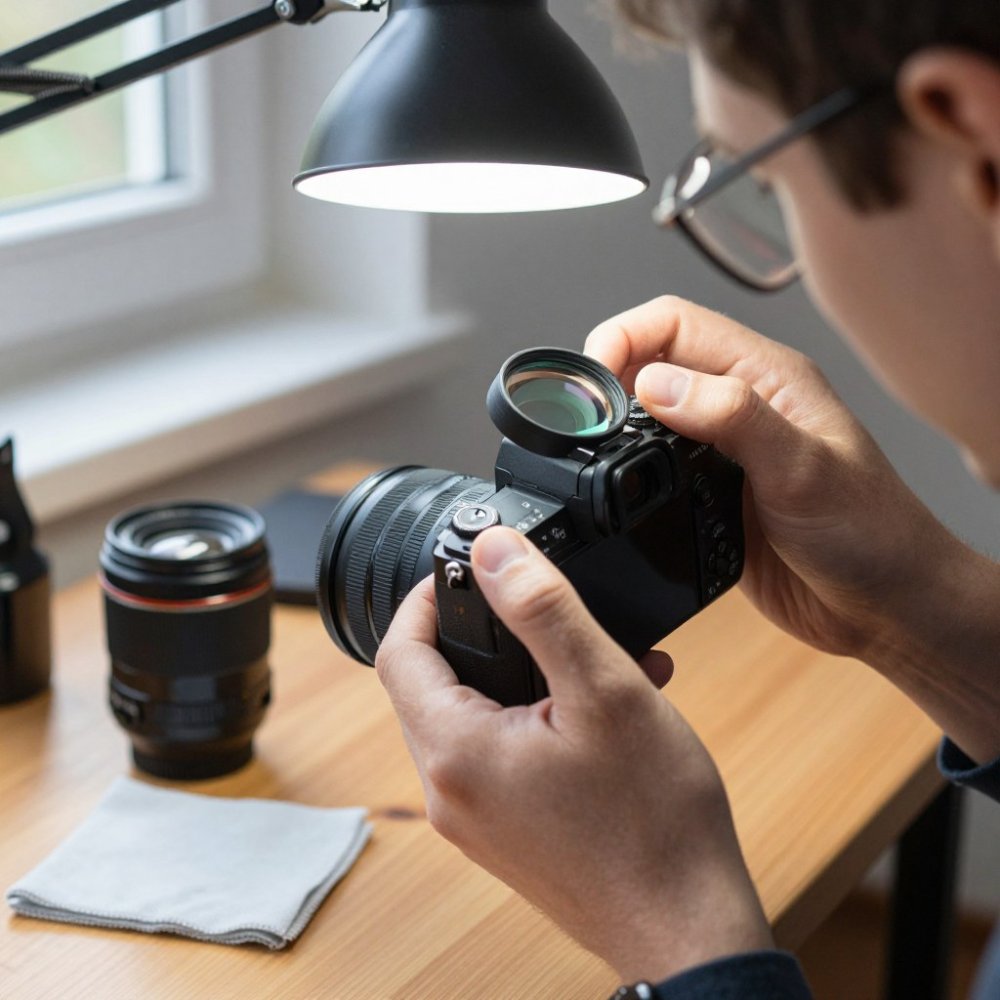
Bring a charged battery, a memory card, and a lens you trust. Ask to shoot a few frames and review them on a laptop or your phone, not just the rear screen. A common mistake is judging a camera by how it feels in the hand and never checking the files.
Battery health and included accessories
Start with the battery, because a tired cell is the most common hidden cost. Ask the seller to show the battery health reading in the camera menu where the model supports it. A swollen battery, a battery that rattles in the compartment, or corrosion on the contacts is a walk-away signal, not a negotiating point.
Then audit the accessories against the original box contents: charger, body cap, hot-shoe cover, strap, cables, and the manual. Missing items are cheap to replace individually but add up, and a missing charger on an older body can be surprisingly hard to source. Confirm the memory card slot type and that any included card is genuine rather than a relabeled counterfeit.
Body checks: sensor, mount, dials and seals
Start with the sensor. Lock the mirror up or remove the lens, set the camera to a small aperture, and shoot a plain bright surface. Dust shows up as dark spots; scratches and fungus show up as smears that won’t blow off. If you want a full walkthrough, our guide on 8 checks to inspect a used camera sensor condition covers each step in detail.
Then work the mechanical parts:
- Lens mount: look for play, bent bayonet tabs, or wobble with a lens attached. A mount that flexes under a mounted lens is a fail.
- Dials and buttons: turn every one through its full range. Sticky or skipping dials are a bad sign, and a mode dial that jumps between settings will ruin shots.
- Seals and ports: check rubber grips for lifting and port covers for cracks. Worn seals mean moisture can get in, and a cracked port cover on a weather-sealed body defeats the seal.
- Battery compartment: look for corrosion or swelling. A swollen battery is a walk-away signal.
- Shutter and mirror: fire a burst in continuous mode and listen for a consistent, clean sound. A grinding or uneven shutter is a repair you don’t want to inherit.
Shutter count and model-specific thresholds
Shutter count is the closest thing to an odometer a camera has, and it belongs in the inspection, not a separate step. Ask the seller to run a shutter-count tool before you meet and send a screenshot with the serial number visible. If the seller can’t or won’t provide it, treat that as information too.
What counts as high depends on the model. Rated shutter life varies by model and class of camera. Rather than memorizing numbers, ask the seller what the rated life is for that specific model and compare it to the reading. A body at half its rated life is a different proposition from one at ninety percent. On a mirrorless body, the electronic shutter may not register the same way, so confirm what the tool is actually counting. Our step-by-step guide on how to check shutter count on used cameras shows where to find the number on common models.
Lens checks: glass, autofocus and aperture blades
Point a light through the lens at an angle. Look for haze, fungus threads, and scratches on the front and rear elements. A little dust is normal; a cloudy element is not. Fungus often shows as a fine web or spider pattern, and haze as a uniform milkiness that won’t wipe away.
Mount the lens and test autofocus at near and far distances. Listen for grinding or hunting, and check that focus confirms on a high-contrast target at both ends of the range. Then stop the aperture down through its range and watch the blades close evenly. Oil on the blades or a stuck diaphragm is a repair you don’t want to inherit. For a fuller checklist, see our guide on what to look for in used lenses.
Pass or fail: the twenty-minute summary
At the end of the inspection, you should be able to answer yes to each of these: battery health acceptable or replacement priced in, sensor clean of scratches and fungus, mount tight with a lens attached, every dial and button working, seals and port covers intact, shutter count verified against the model’s rated life, and lens glass clear with working autofocus and aperture. Any no is either a walk-away or a price adjustment you make before money changes hands.
What Refurbished Camera Condition Grades Actually Tell You
Condition grades are shorthand, and every seller defines them a little differently. „Excellent“ from one dealer may match „good“ from another. Treat the grade as a starting point, not a guarantee, and always read the specific notes attached to the listing.
Most scales run from a mint or like-new tier down through excellent, good, and fair. Cosmetic wear usually doesn’t affect how the camera works, but it should be reflected in the price. What matters is whether the grade describes the body only or also covers the sensor, shutter, and electronics.
If you want to compare how used condition grades stack up against a refurbished grading scale, our article on used camera condition grades versus the grading scale walks through the differences. The takeaway: a grade tells you about appearance, not about how many frames the shutter has fired.
Used Camera Shutter Count and What It Means for Lifespan
Shutter count is the number of frames a camera has fired, and it’s the closest thing to an odometer a camera has. A low count suggests lighter use; a high count means the shutter mechanism is closer to the end of its rated life. Every mechanical shutter has a rated cycle life, and once you pass it, replacement becomes a real cost.
You can often read the count from the camera’s menu or by having the seller run a free tool before you meet. Ask for a screenshot with the serial number visible. If the seller can’t or won’t provide it, treat that as information too.
Our step-by-step guide on how to check shutter count on used cameras shows where to find the number on common models. On a mirrorless body, the electronic shutter may not register the same way, so confirm what the tool is actually counting.
Refurbished Camera Warranty and Return Windows by Seller Type
Warranty coverage is where refurbished cameras earn their higher price. A private seller typically offers nothing once you’ve paid. A dealer usually offers a limited warranty and a return window, and a manufacturer refurbished unit comes with the strongest terms of the three.
| Seller type | Typical warranty | Return window | Buyer protection |
|---|---|---|---|
| Private seller | None, sold as seen | None, or goodwill only | Minimal; rely on inspection |
| Dealer, seller refurbished | Limited, often 6-12 months | Short, often 14-30 days | Moderate; read the fine print |
| Manufacturer refurbished | Full or limited maker warranty | Standard distance-selling rights | Strongest of the three |
If you’re weighing specific dealers, our comparison of KEH versus MPB for used gear lays out how their warranty and return policies differ side by side. In practice, the return window matters as much as the warranty: it’s your chance to catch a fault the seller missed.
Price, Savings and Total Cost of Ownership
A used camera usually has the lowest purchase price, a refurbished camera sits in the middle, and a new camera tops the list. A refurbished camera generally carries a premium over used for inspection, warranty and return options. Whether that premium is worth it depends on what a repair would cost you later, and that is where most buyers stop calculating too early.
The three price tiers in practice
Private used gear is priced by the seller, so the same model can vary widely depending on condition, shutter count, and how quickly the seller wants to move it. Dealer and manufacturer refurbished gear is generally priced above private sales, reflecting the inspection and warranty work involved. Pricing depends on the model, condition and seller, so check current prices with the seller. When you compare listings, compare like with like: a private body with no charger and a high shutter count is not the same product as a dealer-refurbished body with a warranty, even if the model name matches.
Warranty and return mechanics by seller type
The warranty is not a single thing; it is a bundle of coverage length, exclusions, who handles repairs, and how long you have to return the item. A private seller typically offers nothing once you’ve paid. A dealer usually offers a limited warranty and a short return window, and a manufacturer refurbished unit comes with the strongest terms of the three.
| Seller type | Typical warranty | Return window | Who handles repairs |
|---|---|---|---|
| Private seller | None, sold as seen | None, or goodwill only | You |
| Dealer, seller refurbished | Limited, often 6-12 months | Short, often 14-30 days | The dealer |
| Manufacturer refurbished | Full or limited maker warranty | Standard distance-selling rights | The maker’s service arm |
Read the exclusions before you buy. Common exclusions include water damage, impact damage, and wear items such as batteries and rubber grips. The return window matters as much as the warranty: it’s your chance to catch a fault the seller missed, and it is often the only protection you have in the first month. If you’re weighing specific dealers, our comparison of KEH versus MPB for used gear lays out how their warranty and return policies differ side by side.
Total cost of ownership: what to add to the sticker price
Total cost of ownership can include extras beyond the purchase price, such as a spare battery, a memory card, a cleaning or service visit, and any missing accessories. A used body that needs a sensor clean, a new battery, or a charger can narrow the gap with a refurbished unit, depending on the repairs required.
Price the camera, then add the likely service costs before you compare. A refurbished body with documented service history tends to hold its value better than a private-sale body with an unknown past, because the next buyer faces the same questions you did.
Watch out: a listing that looks cheapest on the sticker can be the most expensive option once a battery, charger, card, and sensor clean are added, so build the full number before you decide.
Reliability, Defects and the Real Risk of Each Option
Reliability comes down to who checked the camera and what happens if something fails. A refurbished camera has usually been tested before resale. A used camera from a private seller has been tested by you, once, in a parking lot.
The most common defects on used bodies are sensor dust, worn seals, sticky dials, and a tired shutter. Lenses add fungus, haze, and autofocus motor wear. None of these are rare, and most are invisible in a quick hands-on check.
That’s the trade-off. Refurbished gear reduces risk but doesn’t eliminate it, and a dealer’s return window can serve as a safety net. A private sale saves money but puts the entire inspection burden on you. Neither option is wrong; they just suit different buyers.
Pros and Cons Side by Side
Here’s the comparison in plain terms.
Used camera, private sale:
- Pros: lowest price, widest choice of models, room to negotiate.
- Cons: no warranty, no return window, full inspection burden on you.
Refurbished camera, dealer or manufacturer:
- Pros: inspected and tested, warranty coverage, return window, buyer protection.
- Cons: higher purchase price, smaller selection, terms vary by seller.
Best for: a patient buyer who enjoys inspecting gear and knows the models. Skip if: you need a camera working reliably next week with no repair budget.
Best for: a first-time buyer or anyone who wants backup if something fails. Skip if: you’re chasing the absolute lowest price and can inspect confidently.
Which Buyer and Use Case Fits Which Camera
Students and hobbyists on a tight budget often do best with a used camera from a reputable private seller, provided they inspect it properly and check the shutter count. The savings free up money for a good lens, which affects image quality far more than the body does.
First-time buyers, gift shoppers, and anyone buying for a trip or an event should lean refurbished. The warranty and return window are worth the premium when you can’t afford a failure. Professionals who need a dependable second body should also look at manufacturer refurbished units.
The decision rule is simple: if you can’t inspect the camera in person or don’t know what to look for, pay for the warranty.
Build Your Shortlist With Kameratalk
The used camera versus refurbished camera decision comes down to how much risk you want to carry and how much you’re willing to pay to hand it off. Inspect carefully, check the shutter count, read the warranty terms, and price the likely service costs before you commit.
At Kameratalk, we help photographers cut through the listings and buy gear with confidence. Our community and guides cover analog and digital camera equipment, buying advice, and the practical checks that save you from a bad purchase. Start with our buying guides, compare condition grades, and shortlist the models that fit your budget.
Ready to find your next camera without the guesswork? Kameratalk brings together gear guides, buying checklists, and a community of photographers who’ve been where you are. Explore our resources, compare your shortlist, and buy with confidence.
Frequently Asked Questions
What is the difference between a used and a refurbished camera?
A used camera is sold as it was traded in, with whatever cosmetic wear and history it carries. A refurbished camera has been inspected, cleaned and, where needed, repaired or fitted with replacement parts before resale, and it usually comes with a condition grade and a warranty. The practical difference is not the age of the camera but the quality check behind it: refurbished gear carries documented testing, while a private used sale often carries none.
Do refurbished cameras come with a warranty?
It depends on the seller. Manufacturer refurbished bodies typically include a limited warranty, often shorter than the one on a new camera. Authorized retailers usually offer their own warranty plus a return window. Private sellers generally offer neither, so the warranty is often the main thing you are paying extra for when you compare a refurbished camera with a used one.
How do I check the shutter count on a used camera?
Most digital bodies record the shutter actuations in the EXIF data of a photo. Take a test shot at the viewing, then read the file with a free EXIF tool on your phone or laptop. Compare the figure with the rated shutter life for that model, which manufacturers publish.
Is it safe to buy a used camera online?
It can be, if you reduce the risk before paying. Ask for the shutter count, photos of the sensor and mount, and the serial number, then check the seller’s reputation and history. Pay through a method with buyer protection rather than a direct bank transfer, and confirm the return policy in writing. Buying from a refurbisher with a warranty and a return window removes most of the guesswork, which is why many buyers accept the higher price.