
Last Updated: November 21, 2026
Quick Summary
Camera condition grades are seller-specific labels describing a used camera’s cosmetic and functional state, while a grading scale is the full system a seller uses to order those labels. No industry-wide standard exists, so the same label can mean different things at different dealers. Always confirm each seller’s own written definition before you buy.
- A grade label is a seller’s own assessment, not a warranty or standardized measurement.
- Common labels run from Mint down to As-Is, with Near Mint, Excellent, Very Good, Good, Fair, and Poor between.
- Cosmetic and functional condition are independent measures that a single grade label usually blurs together.
- Ask sellers for a written cosmetic description, functional statement, shutter count, and return terms.
- A Good-grade body with a verified low shutter count is often the smarter buy for long-term shooters.
Table of Contents
- Why Used Camera Condition Grades and Grading Scales Diverge
- What a grade label actually promises
- Used Camera Condition Grades Explained: The Common Labels
- Cosmetic Condition vs Functional Condition: Two Separate Scores
- How Grading Scales Differ Between Sellers
- Translating Grades Across Sellers: A Practical Chart
- How to Inspect a Used Camera Before You Commit
- Used Camera Inspection Checklist for Body, Lens, and Controls
- Camera Shutter Count and Condition: What the Number Tells You
- Verifying a Grade From Listing Photos and Seller Questions
- How Condition Affects Resale Value and Depreciation
- Frequently Asked Questions
Why Used Camera Condition Grades and Grading Scales Diverge
Camera condition grades are seller-specific labels that describe the cosmetic and functional state of a used camera, while a grading scale is the full system a particular seller uses to arrange those labels in order. The two are not the same thing, and confusing them is the single most common reason buyers end up disappointed.
Here is the core problem. There is no binding, industry-wide standard for used camera condition grades. Each dealer publishes its own scale, defines its own terms, and applies its own judgment. That means the word on the label tells you almost nothing until you know which scale it belongs to.
Below, we break down what each label actually promises, how the major scales differ, and how to verify a grade before you pay. The payoff is simple: you can match the price you pay to the condition you actually receive.
What a grade label actually promises
A grade label promises a seller’s own assessment of an item’s condition, nothing more. It is a shorthand summary, not a warranty and not a standardized measurement. This is the part most buyers get wrong.
Think of it as a claim the seller is making. „Excellent“ means the seller believes the item sits in the upper band of its condition range. It does not mean the camera is flawless, and it does not mean another seller would grade it the same way. Two shops can look at the same body and reach different conclusions, both in good faith.
So what should you actually expect from a label? Three things, at minimum:
- A description of cosmetic condition, meaning visible wear, scuffs, and marks
- A statement about functional condition, meaning whether the camera operates correctly
- A list of included items, meaning what ships in the box
If a listing gives you a grade but skips any of those three, treat the grade as incomplete. A label without a functional statement is a cosmetic opinion wearing a suit.
Used Camera Condition Grades Explained: The Common Labels
Mint describes an item that appears unused or as close to new as a used item can be. Expect no visible wear.
Near Mint means very light use with only faint signs of handling. No dents, no deep scratches, glass clean.
Excellent signals light wear that is visible on close inspection but does not affect function.
Very Good shows moderate cosmetic wear: brassing, small marks, maybe a light scratch on the LCD. Everything still works.
Good means clear wear and tear, with obvious cosmetic flaws, but full functionality.
Fair indicates heavy wear and possibly minor functional quirks that the seller should disclose.
Poor means significant damage or missing function, sold cheaply for parts or repair.
As-Is means exactly that: no guarantees, no returns, sold on the assumption it may not work at all.
Watch out: a „Mint“ label with no photos of the actual item is a red flag.
Cosmetic Condition vs Functional Condition: Two Separate Scores
Cosmetic and functional condition are two independent measures, and a single grade label usually blurs them together. This is the distinction we wish every buyer internalized before shopping.
A camera body can look rough and work perfectly. A camera can look pristine and have a dead autofocus motor. The grade on the listing often reflects the cosmetic side more heavily, because that is what photos show. Function is invisible until you test it.
Here is how to think about the split:
| Condition type | What it covers | How you verify it |
|---|---|---|
| Cosmetic | Scuffs, scratches, dents, brassing, LCD marks | Listing photos, close-up shots |
| Functional | Shutter, autofocus, metering, controls, sensor | Testing, seller questions, return policy |
| Optical | Lens glass, coating, dust, fungus, haze | Lens photos, torch test on arrival |
| Mechanical | Dials, mounts, mirror box, film advance | Hands-on checks, function tests |
Our advice: demand a separate statement for each. A seller who only talks about how the camera looks is telling you half the story. When you evaluate a used lens, the optical side matters far more than a scuff on the barrel, which is why we walk through what to look for in used lenses separately.
How Grading Scales Differ Between Sellers
Grading scales differ between sellers because each business builds its own system, and those systems do not translate cleanly. Some use words, some use numbers, some use letter codes, and some mix all three. The result is that the same label can describe two different realities depending on where you shop.
Some dealers publish a 100-point numerical scale, while others use word labels or letter codes. A score from one dealer’s scale means nothing at another dealer.
Some sellers explain their condition grades in prose, while others publish numeric or letter-based scales with their own abbreviations.
The takeaway is blunt: grade abbreviations are local dialect, not a universal language. If you are weighing two marketplaces directly, our KEH vs MPB comparison shows how differently two major sellers structure and describe condition.
Numerical scales, letter grades, and abbreviations
Three formats dominate. Numerical scales assign a score, often out of 100 or out of 10, which feels precise but is still a seller’s judgment. Letter grades run from A down to D and map loosely to the word labels. Abbreviations like EX+, VG+, and LN- are shorthand for Excellent plus, Very Good plus, and Like New minus, where the plus and minus nudge the item up or down within its band.
None of these formats is more „correct“ than another. What matters is reading the seller’s own definition, not assuming the label means what it meant at your last purchase.
A practical grade-to-grade crosswalk
The chart below maps the common labels across the formats most sellers use. Read it as a translation layer, not a conversion table: a „Good“ from one seller may sit closer to another seller’s „Very Good,“ and a numerical score of 90 does not mean the same thing at two different shops.
| Plain band | Common word label | Typical abbreviation | Typical numeric band (where used) | What to expect |
|---|---|---|---|---|
| As new | Mint / New / Like New | N, LN | 98-100 | No visible wear, often boxed |
| Near new | Near Mint / Like New minus | NM, LN- | 95-97 | Faint handling marks only |
| Light wear | Excellent | EX, EX+ | 90-94 | Minor scuffs, fully functional |
| Moderate wear | Very Good | VG, VG+ | 80-89 | Brassing, small marks, works |
| Clear wear | Good | GD | 70-79 | Obvious cosmetic flaws, works |
| Heavy wear | Fair | FR | 50-69 | Heavy wear, possible quirks |
| Damaged | Poor | PR | Below 50 | Damage or missing function |
| Untested | As-Is | AI | Not graded | No guarantee, sold as seen |
The numeric bands are illustrative of how sellers commonly cluster their scores, not a published standard. Where a seller publishes its own bands, that seller’s definition wins.
Watch out: a direct equivalence between an abbreviation and a word label is unreliable at the boundaries. „EX+“ at one shop can be another shop’s „Near Mint,“ and a „VG+“ can be a third shop’s „Excellent.“ Always confirm against the seller’s own written definition before you commit, and treat the crosswalk as a starting point for questions rather than a verdict.
Where the scales genuinely diverge
The deepest divergence is not in the words but in what each scale weighs. Some sellers grade almost entirely on cosmetics, so a body with a flawless shell but an unknown shutter count can still earn a top label. Others grade on function first and treat cosmetic wear as a secondary note.
A second divergence is the treatment of accessories and completeness. One seller’s „Mint“ may require the original box, caps, strap, and manual; another’s „Mint“ may mean the body alone.
A third is the age of the item. Vintage and discontinued gear is often graded on a curve, where „Excellent“ for a forty-year-old body means something very different from „Excellent“ for a current model. The label is relative to the seller’s expectations for that class of equipment, not an absolute measure.
How to compare two listings without a shared scale
When two sellers use different systems, do not compare the labels directly. Compare the underlying facts. Ask each seller for the same four pieces of information: a written cosmetic description, a written functional statement, the shutter count where the model records it, and the return terms. Put the answers side by side and the labels become almost irrelevant, because you are now comparing evidence rather than vocabulary.
If one seller will not provide those facts in writing, that absence is itself a data point. A grade without supporting detail is a claim, and a claim you cannot verify is worth less than a lower grade you can.
Translating Grades Across Sellers: A Practical Chart
Translating grades across sellers requires mapping each label to a plain-language condition band rather than to another seller’s word. Use this chart as your translation layer.
| Plain band | Common word label | Typical abbreviation | What to expect |
|---|---|---|---|
| As new | Mint / New / Like New | N, LN | No visible wear, often boxed |
| Near new | Near Mint / Like New minus | NM, LN- | Faint handling marks only |
| Light wear | Excellent | EX, EX+ | Minor scuffs, fully functional |
| Moderate wear | Very Good | VG, VG+ | Brassing, small marks, works |
| Clear wear | Good | GD | Obvious cosmetic flaws, works |
| Heavy wear | Fair | FR | Heavy wear, possible quirks |
| Damaged | Poor | PR | Damage or missing function |
| Untested | As-Is | AI | No guarantee, sold as seen |
Read the chart as a translation, not a conversion. A „Good“ from one seller may sit closer to another seller’s „Very Good.“ Always confirm against the seller’s own written definition before you commit.
How to Inspect a Used Camera Before You Commit
Inspection is where a grade stops being a word and becomes a fact. A grade label is the seller’s claim; your inspection is the verification. Do it before money changes hands, or immediately on arrival within the return window.
Start with the body in your hands. Check every dial and button for smooth operation. Look at the lens mount for wear. Open the battery compartment and card slot. Then move to function: fire the shutter, test autofocus at near and far distances, and run through the metering modes.
For shutter accuracy specifically, we keep a separate guide on how to test a used camera’s shutter speed, because timing errors are easy to miss and expensive to fix. Pair that with a sensor check, since the sensor is the most critical and most easily damaged component.
A common mistake is testing only in bright light. Dim conditions expose autofocus hunting and metering errors that daylight hides.
Used Camera Inspection Checklist for Body, Lens, and Controls
A used camera inspection checklist should cover the body, the lens, and the controls as three separate passes. Work through this list methodically.
Body:
- Check for dents, cracks, and deep scratches on the shell
- Inspect the lens mount for wear or play
- Open and close the battery door and card slot
- Look for impact marks near the corners
Lens:
- Shine a torch through the glass at an angle
- Check for dust, fungus, haze, and scratches
- Test the focus ring and zoom for smooth travel
- Confirm the aperture blades move freely
Controls and function:
- Fire the shutter at several speeds
- Test autofocus near and far
- Run through metering modes
- Check the LCD screen and viewfinder for marks
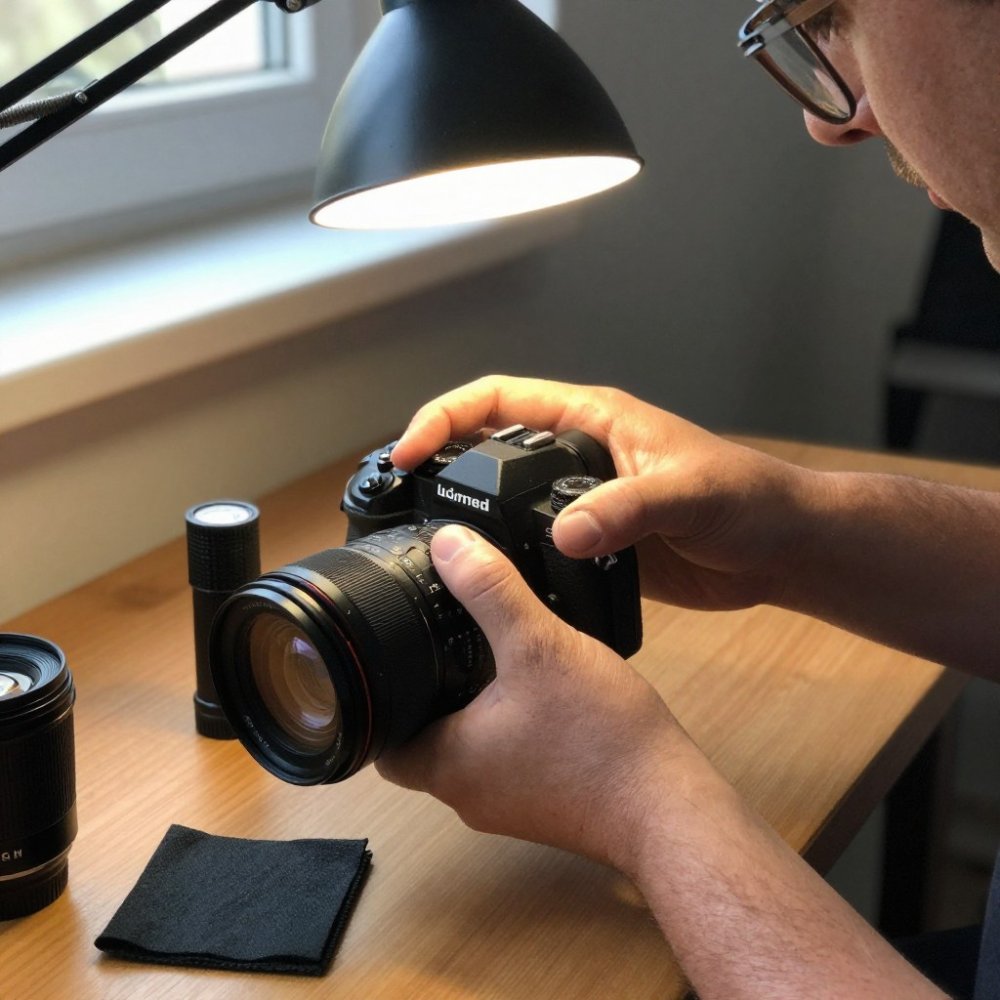
For the sensor specifically, our focused guide on how to inspect a used camera sensor walks through the torch-and-aperture method step by step. Fungus and haze are the two defects that most often get missed, and both live on the glass, not the body.
Camera Shutter Count and Condition: What the Number Tells You
Shutter count is the number of actuations a camera’s shutter has fired, and it is the closest thing to an odometer a digital body has. It tells you how much mechanical life the shutter has used, which no cosmetic grade can show you.
A camera that looks Mint cosmetically may have a high shutter count from studio use. A cosmetically worn body may have a low count from careful amateur ownership. The grade and the count measure different things, and both matter.
Reading shutter count alongside the grade
Read the count as a second opinion on the grade, not a replacement for it. A high count on a body graded Excellent is not automatically a problem; shutters are rated for a service life and many outlive it. But a high count paired with a „Mint“ label deserves a question.
Ask the seller for the count in writing. If they cannot provide it, factor that into your offer. Many mirrorless bodies record the count in the menu or via a file’s metadata, and our guide on how to check shutter count shows the method for common models. Treat the count as one data point among several, never the whole verdict.
Verifying a Grade From Listing Photos and Seller Questions
Verifying a grade comes down to two moves: reading the listing photos closely and asking the seller direct questions. Photos show cosmetics; questions surface function. Do both.
On the photos, zoom in on the corners, the lens mount, and the LCD. Look for brassing, which shows as bright metal where the black coating has worn. Check whether the photos show the actual item or a stock image. A listing that reuses manufacturer images is telling you nothing.
Then ask, in writing:
- „Can you confirm the shutter count?“
- „Are there any marks on the sensor or LCD?“
- „Does everything function, including autofocus and metering?“
- „What is your return policy if the item does not match the grade?“
Keep the answers. A seller who answers specifically is more trustworthy than one who replies with the grade label again. If a grade claim and the photos disagree, trust the photos and walk away.
How Condition Affects Resale Value and Depreciation
Condition drives resale value more than almost any other factor, and the gap between adjacent grades can be substantial. A Near Mint body will typically hold far more of its value than a Good one, and the difference compounds when you later sell. But the mechanism is more specific than „better grade, better price,“ and understanding it changes how you buy.
Cosmetic and functional condition depreciate on different curves
Cosmetic wear and functional wear do not move together on the resale market. Cosmetic condition sets the ceiling on what a buyer will pay, because it is the first thing a listing photo shows and the easiest thing to compare across listings. Functional condition sets the floor, because a buyer who needs a working camera will pay for function even when the shell is rough, but will walk away from a clean body that does not operate.
The practical consequence is that a cosmetically worn but fully functional body often depreciates more slowly in percentage terms than a pristine body with an unknown service history. The pristine body starts higher and has further to fall; the worn body has already absorbed most of its cosmetic depreciation and is priced for shooters rather than collectors.
Completeness is a separate value axis
Accessories and completeness behave like a third grade that sellers rarely state explicitly. Original box, caps, strap, manual, charger, and batteries all add resale value, and a complete set in Good condition can outsell a body-only example in Very Good condition. When you compare two listings, compare what ships in the box before you compare the labels, because a grade that bundles accessories is not the same product as a grade that does not.
Age and model status change the depreciation band
Depreciation is not uniform across the market. Current-model bodies lose value fastest in the first period after release and then settle. Discontinued models with a strong following can flatten or even firm up as supply of clean examples shrinks. Vintage and collectible gear can behave differently again, where originality and completeness matter more than a working shutter. A grade label does not tell you which band an item sits in; the model and its market position do.
A practical way to think about the trade-off
Buy the grade that matches how you will actually use the camera. If you shoot professionally and resale matters, a higher cosmetic grade protects your investment because the pool of buyers who will pay top money for a clean body is deeper.
Watch out: do not assume a high cosmetic grade guarantees strong resale. A Mint body with a high shutter count or an unknown service history can be harder to sell later than a Very Good body with documented low use, because the next buyer will ask the same questions you should be asking now.
The used market rewards buyers who read past the label. Kameratalk is built for exactly that: a place to compare gear, learn the checks that matter, and talk through a purchase with people who shoot.
Frequently Asked Questions
What do the condition grades for used cameras mean?
Condition grades describe how much an item has been used and how it looks and works. Mint and Near Mint usually mean almost no visible wear, Excellent and Very Good mean light signs of use, Good and Fair mean clear cosmetic marks, and Poor or As-Is means defects or faults. The label is only reliable when the seller publishes what each grade includes, so read the description rather than trusting the word alone.
Are used camera grading scales the same across sellers?
No. One seller may use a 100-point numerical scale, another letter grades from A to D, and another abbreviations like EX+ or VG+. No single format applies across the market, and a score from one retailer is not directly interchangeable with another’s grade. Always check the seller’s own published scale before comparing two listings.
What is the difference between cosmetic condition and functional condition?
Cosmetic condition covers visible wear: scuffs, scratches, dents, and shine on the body or lens barrel. Functional condition covers whether the camera actually works: shutter accuracy, autofocus, metering, LCD screen, viewfinder, and lens glass free of fungus or haze. A body can look Excellent and still have a failing shutter, so treat the two as separate questions and ask for both.
What should I check when buying a used camera?
Run through the body, lens, and controls. Check for dents and scuffs, look through the viewfinder, test the LCD screen, fire the shutter at several speeds, and confirm autofocus and metering respond. Inspect lens glass for dust, fungus, and scratches, and check the mount and aperture ring. Ask for the shutter count and confirm which accessories and included items come with the sale.
Does a higher camera condition grade guarantee that everything works?
No. A high cosmetic grade says the item looks clean, not that every function has been tested. Ask the seller directly whether the camera is fully functional, whether the shutter has been checked, and whether returns are accepted if a fault appears. A grade is a starting point for the conversation, not a warranty.