
Last Updated: November 25, 2026
Quick Summary
A refurbished camera is a camera a technician has inspected, tested and repaired where needed, then graded before resale, so it delivers the same images as a new one for less. Buy manufacturer refurbished where possible, confirm the warranty terms and return window in writing, and check shutter count, sensor condition and battery health before paying.
- Manufacturer refurbished is the safest tier because the brand restores the camera and backs it with its own warranty.
- Condition grades vary by seller, so read the written description instead of trusting the label alone.
- A good warranty states its length, scope, who repairs and how you file a claim.
- Confirm whether a faulty unit is treated differently from a change of mind before you buy.
- Decide which two or three lenses you want before you pick the body.
Table of Contents
- Why a Refurbished Camera Beats New for Most Buyers
- Refurbished vs Used Camera: The Difference That Changes Your Risk
- Camera Condition Grades Decoded Before You Pay
- Refurbished Camera Warranty: What Coverage Should Include
- Returns, Trial Periods and Refunds Compared Side by Side
- The Buying a Used Camera Online Checklist for Every Listing
- Lens Compatibility and Choosing Gear That Fits Your Mount
- Total Cost of Ownership: Body, Lens, Battery and Accessories
- Inspecting Your Camera the Day It Arrives
- Building Your First Refurbished Kit at Kameratalk
- Frequently Asked Questions
Why a Refurbished Camera Beats New for Most Buyers
Buying a refurbished camera online is the smartest money move most photographers never make. A camera that has been professionally checked, cleaned and restored delivers the same images as a new one, often for a fraction of the outlay, and it leaves more budget for the part that actually shapes your photos: the lens.
A refurbished camera is not a damaged camera. It is a camera that a technician has inspected, tested and repaired where needed, then graded before resale.
Below, we walk through what separates a good refurbished deal from a costly mistake, how grades and warranties really work, and the checklist we would use ourselves before paying for any listing.
Refurbished vs Used Camera: The Difference That Changes Your Risk
The refurbished vs used camera question comes down to one thing: who did the checking, and can you prove it. A used camera is sold as-is by whoever owns it. A refurbished camera passes through an inspection and repair process first, and that process is what you are paying for.
Manufacturer refurbished means the brand itself restored the camera, usually a returned or ex-display unit, and backs it with its own warranty. This is the safest tier. Seller refurbished means a dealer or repair shop did the work instead. Quality varies enormously here, so the seller’s reputation and paperwork matter more than the label. Plain used means no restoration at all, which is fine if you know what you are doing and price the risk in.
If you are weighing these two routes directly, our guide on used camera vs refurbished camera lays the trade-offs out side by side.
Manufacturer Refurbished, Seller Refurbished and Plain Used
Think of it as three risk levels. Manufacturer refurbished sits at the low end, with a known process and a real warranty behind it. Seller refurbished sits in the middle, where the shop’s track record decides everything. Plain used sits at the top, where you carry the risk and the reward.
A common mistake is treating „refurbished“ as one uniform promise. It is not. Ask who refurbished the camera, what they replaced, and what happens if it fails in month three.
Camera Condition Grades Decoded Before You Pay
Camera condition grades are shorthand, and every seller defines them a little differently. That is the trap. „Excellent“ from one shop can mean what „good“ means at another, so always read the written description rather than trusting the label alone.
Most scales run from a mint or like-new tier down through excellent, good and fair. Cosmetic marks are usually disclosed separately from functional condition, and a scuff on the baseplate tells you nothing about the sensor. We care far more about the functional notes than the cosmetics.
For a deeper walk through how grading scales differ between sellers, see our breakdown of used camera condition grades versus the grading scale.
Shutter Count, Sensor Condition and Battery Health
Three numbers tell you more about a camera’s real life than any grade label.
- Shutter count: the number of actuations on a mechanical shutter. Lower is generally better, but a well-serviced high-count body can outlast a neglected low-count one.
- Sensor condition: look for scratches, dust that will not blow off, and any sign of impact damage. Ask for a test image shot at a small aperture against a plain background.
- Battery health: original batteries age. A cheap third-party cell in the box is a hint about how the rest of the kit was treated.
If you want the step-by-step method for verifying actuations before you pay, read our guide on how to check shutter count on used cameras. And for a full inspection routine, our eight checks to inspect a used camera sensor walks through exactly what to look for.
Refurbished Camera Warranty: What Coverage Should Include
A refurbished camera warranty is the single most important line in any listing, and it is the one buyers skim past. Good coverage should state its length in writing, name what is covered, and explain who performs the repair.
Here is what we would want to see spelled out:
- Length: a clear term, counted from delivery, not from purchase.
- Scope: mechanical faults, sensor defects and electronic failures named explicitly.
- Who repairs: the seller, the manufacturer, or an authorised service partner.
- Process: how you file a claim, and whether shipping is covered.
- Exclusions: wear items like batteries and rubber grips are often excluded, which is fair if it is stated upfront.
A warranty that only covers „manufacturing defects“ and requires you to prove the fault existed on arrival may offer limited protection in practice. Ask for the terms in writing before you pay, and keep the confirmation email.
Returns, Trial Periods and Refunds Compared Side by Side
Return rights are where listings quietly diverge, and they matter more than any spec sheet. A generous trial period lets you test autofocus, check the sensor and confirm the mount all work as promised. A short one turns a bad unit into your problem. The table below is the comparison we would run before paying, with the specific question to ask for each row.
| Policy area | What to check | The question to ask the seller | Why it matters |
|---|---|---|---|
| Return window | Days from delivery, in writing | „How many days from delivery do I have, and is that calendar or working days?“ | Time to test properly |
| Condition rules | Unused vs tested-and-returnable | „Can I shoot test frames and still return it, or must it stay sealed?“ | Whether you can actually shoot with it |
| Refund method | Original payment vs store credit | „Will the refund go back to my original payment method?“ | Cash back beats a voucher |
| Return shipping | Who pays, and how much | „Who covers return shipping on a faulty unit versus a change of mind?“ | Can erase the savings |
| Restocking fee | Percentage or flat amount | „Is there a restocking fee, and does it apply to faults?“ | A hidden cost on returns |
| Defect vs change of mind | Different rules for each | „What evidence do you need to treat this as a fault rather than a change of mind?“ | Faults should always be covered |
The comparison we would run first is simple: does the seller treat a genuine fault differently from a change of mind? They should. A camera that arrives faulty is the seller’s problem, not yours, and a fair policy says so plainly. A policy that applies the same restocking fee to a dead sensor as to a buyer who changed their mind is a warning sign, not a neutral term.
Three mechanisms decide whether a return right is real or decorative. First, the clock: a window counted from dispatch rather than delivery can lose several days in transit, so confirm the start date. Second, the condition test: some sellers require the camera to be unused and in unopened packaging, which makes the trial period meaningless for a camera you are supposed to test. Third, the refund route: store credit is not a refund, and a voucher you cannot spend on the lens you need is worth less than the number on it.
Watch out: a „14-day return“ that excludes shipping costs and charges a restocking percentage can cost more than the discount you chased, so price the worst-case return before you buy. Keep the listing, the policy page and your messages saved, because a return dispute is decided on what was written, not on what was said.
For a broader walk through buying from online portals, our guide to buying used cameras from online portals covers payment safety and dispute resolution in more depth.
The Buying a Used Camera Online Checklist for Every Listing
Use this buying a used camera online checklist before you commit to any listing. It takes ten minutes and saves you from the expensive surprises.
- Confirm the exact model, mount and whether a lens is included
- Read the full condition description, not just the grade
- Ask for the shutter count in writing
- Request recent test images at a small aperture
- Check battery type, age and whether a charger is included
- Read the warranty terms line by line
- Confirm the return window and who pays return shipping
- Verify the seller’s identity, address and contact details
- Check delivery cost and estimated timeframe
- Pay with a method that offers buyer protection
- Save the listing, photos and all messages
For a broader walk through buying from online portals, our guide to buying used cameras from online portals covers payment safety and dispute resolution in more depth.
Lens Compatibility and Choosing Gear That Fits Your Mount
Lens compatibility decides whether a bargain body becomes a system or a dead end. Every camera has a mount, and lenses are built for specific mounts. Buy a body with an orphaned mount and you will struggle to find glass at a sensible price. This is the section most buying guides skip, so treat it as the compatibility and intended-use check that decides whether the discount is real.
Start with the mount family, not the model. The major SLR and mirrorless systems each have their own bayonet, and within a family there are generations that do not always talk to each other. A body from a discontinued line may still take lenses from the same maker, but autofocus, metering and stabilisation can behave differently depending on the adapter and the lens generation. Confirm the exact mount name in the listing, not just the brand.
Then match the sensor size to the lenses you can afford. A full-frame lens on an APS-C body works with most systems but changes your effective field of view, which matters most for wide-angle work. A crop-sensor lens on a full-frame body may vignette heavily or force a crop mode that throws away resolution. Neither is fatal, but both change what you can shoot.
Adapters can bridge different mounts, and the trade-offs are specific. A simple mechanical adapter preserves infinity focus but loses autofocus and electronic aperture control. A smart adapter restores autofocus and exposure but adds cost, bulk and sometimes slower focus, especially with older adapters and third-party lenses. Stabilisation may not pass through, and some adapters disable in-body stabilisation entirely. Test the combination you plan to use before you commit to the body.
A useful rule: decide which two or three lenses you want before you pick the body. If the lenses you can afford do not exist for that mount, the body is the wrong choice, however good the deal looks. Write down the focal lengths you actually shoot, check that those lenses exist in the mount at a price you can pay, and only then compare bodies.
Finally, match the body to intended use. A beginner is usually better served by a body with a common mount, a kit lens that covers wide to short telephoto, and reliable autofocus for everyday subjects. A video-first buyer needs to check whether the mount has lenses with quiet autofocus and whether the body offers the frame rates and ports required. A professional buying a second body should confirm the mount matches the lenses already in the bag, because a second system means a second set of glass. The mount is the long-term decision; the body is the short-term one.
Total Cost of Ownership: Body, Lens, Battery and Accessories
Total cost of ownership is where refurbished quietly wins. The body is only the first payment. A realistic kit needs a lens, a spare battery, a charger, a memory card, a bag and often a cleaning kit.
Budget for the whole kit, not the headline price. A cheaper body that needs a new battery and a card immediately can cost more than a slightly dearer one that ships complete. Ask what is in the box, and price the gaps yourself before you commit.
There is a circular economy argument here too. Buy sensibly, and the camera you buy today funds part of the one you buy next.
Inspecting Your Camera the Day It Arrives
Inspect the camera the day it arrives, before the return window starts ticking down. Unbox on a clean, well-lit surface and work through a short routine while you still have time to send it back.
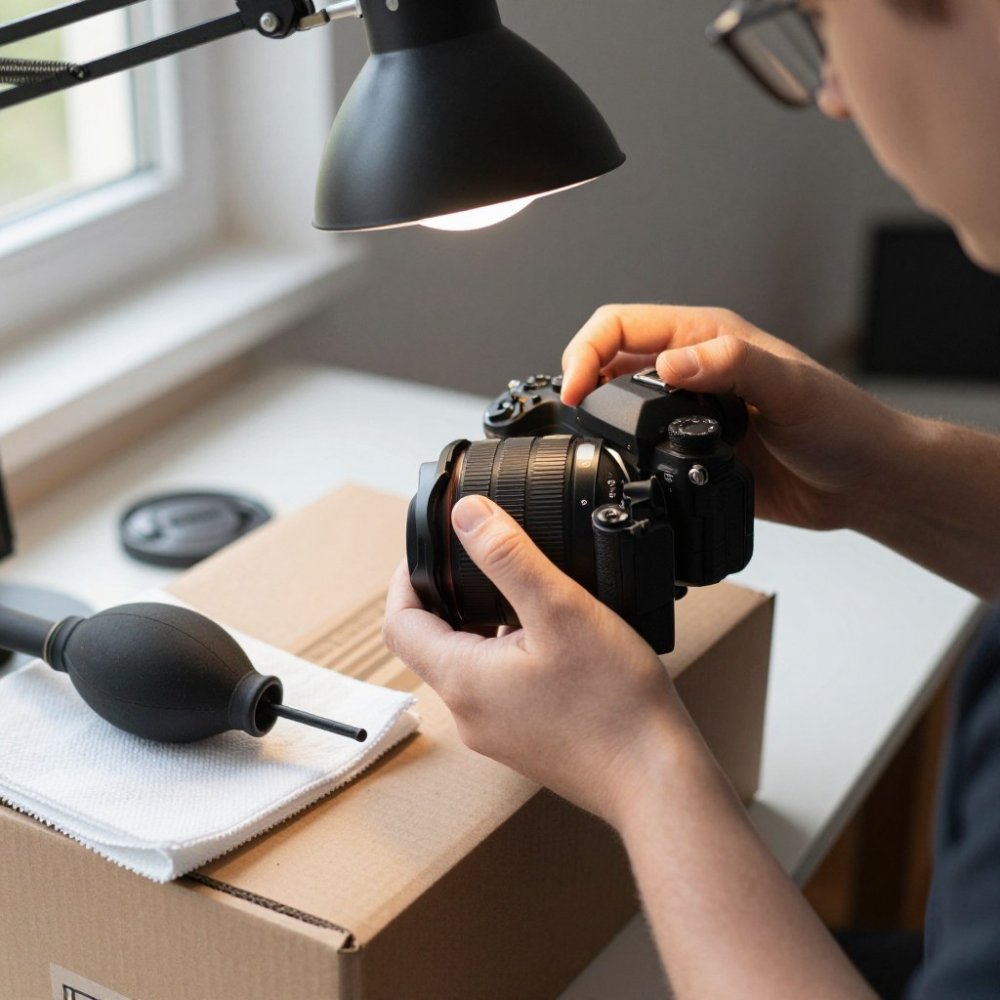
Start with the body: check for cracks, dents and loose dials. Mount a lens and confirm it locks without play. Fire a few frames and listen for anything unusual. Then run the sensor check: set a small aperture, shoot a plain bright surface, and look for dark spots or streaks in the image.
Test autofocus in both bright and dim light, and check every button and dial responds. Confirm the battery charges and holds. If anything fails, document it with photos and contact the seller immediately, while your return rights are still live.
Building Your First Refurbished Kit at Kameratalk
Building a first kit is easier when you buy the right things in the right order. Start with the body and one good lens, add a spare battery and a card, then grow from there as you learn what you actually shoot.
Kameratalk focuses on analog and digital camera expertise, gear and community.
Ready to build a kit that actually fits how you shoot? Get started with Kameratalk and explore our gear guides, buying checklists and community advice, all built around real cameras and real budgets.
Frequently Asked Questions
Is it safe to buy a refurbished camera online?
It can be, provided you buy from a seller that states the refurbishment scope in writing and backs it with a warranty. Check that the listing names the condition grade, lists what was repaired or replaced, and confirms the return window before you pay. Pay by a method that offers buyer protection, keep the listing screenshots, and inspect the camera within the trial period so you can return it if the shutter count or sensor condition does not match the description.
Is a refurbished camera better than a used camera?
Usually yes, because refurbished means someone has inspected, tested and repaired the body before resale, while used often means sold as seen. The refurbished vs used camera distinction comes down to documented work: a refurbished unit should arrive with a condition grade, a repair record and a warranty, whereas a private used sale may offer none of these. You pay more for refurbished, but you carry far less risk and get a route to repair if something fails.
Do refurbished cameras come with a warranty?
Reputable sellers include one, but the length and coverage vary widely. A refurbished camera warranty should state how long it runs, whether it covers parts and labour, who performs the repair, and whether shipping is included. Manufacturer refurbished units often carry a shorter term than new stock but still cover mechanical faults. Read the exclusions too, since water damage and impact are commonly excluded even when the warranty looks generous at first glance.
What should I check before buying a refurbished camera?
Work through a buying a used camera online checklist: confirm the exact model and mount, ask for the shutter count, request sample images at high ISO, and verify battery health and included accessories. Check the condition grade definitions the seller uses, the return window, and whether delivery is insured. Then compare the total price with a lens included against buying the body alone, because a cheap body with no lens often costs more once you add glass and a spare battery.