Table of Contents
- What Makes Candid Wedding Moments Worth Capturing
- Building Trust with Your Couple and Guests
- Best Camera Settings for Documentary Wedding Photography
- Candid Wedding Photography Gear Essentials
- Mastering Natural Light and Environmental Portraits
- Movement, Anticipation, and Fleeting Moments
- Creating Your Candid Wedding Photography Shot List
- Post-Production Workflow for Candid Shots
- Common Mistakes to Avoid
- Frequently Asked Questions
Last Updated: October 2, 2026
What Makes Candid Wedding Moments Worth Capturing
Candid wedding moments are the stories nobody stages. They’re the bride’s father tearing up during the vows, guests laughing so hard they double over, a stolen glance between the newlyweds during dinner. These fleeting moments carry genuine emotion that posed shots simply can’t match.
The challenge is that these moments are unpredictable. You can’t tell a guest to laugh harder or ask the couple to look surprised again. You have to be ready, positioned correctly, and technically prepared when the moment arrives. That’s what separates a photographer who gets lucky from one who consistently delivers candid wedding moments that matter.
The best candid shots happen in the first 30 minutes after guests arrive and during the final hour of the reception. These windows have natural energy and lower expectations, people relax and forget the camera is there.
Building Trust with Your Couple and Guests
Trust is the invisible foundation of candid wedding photography. If your couple is stiff and your guests are aware of the camera, you’ll get stiff photos. If they’re comfortable with your presence, they’ll forget you’re there.
Start this process weeks before the wedding. Have a detailed conversation with your couple about your style. Show them examples of candid wedding photography you’ve done before. Let them know you’ll be moving around, positioning yourself in unexpected places, and sometimes shooting from a distance. When couples understand your approach, they’re far more likely to relax.
On the day itself, arrive early and spend time with guests before the ceremony starts. Chat with them. Make eye contact. Let them see you as a person, not a camera operator. When people know you’re approachable and friendly, they stop performing for the lens.
During the ceremony and reception, position yourself where you’re visible but not intrusive. Don’t hover directly in front of people. Move to the sides and edges. This positioning accomplishes two things: it gives you better angles for candid shots, and it makes you feel less like a threat to natural moments.
One practical mistake many photographers make is treating candid photography like a passive activity. You’re not waiting for moments to happen, you’re creating the conditions where moments can happen. That means being strategic about where you stand, anticipating what’s coming next, and staying alert for the split-second when genuine emotion crosses someone’s face.
If your couple feels watched constantly, they’ll tense up. The result is stiff photos that look staged even though you weren’t directing them. Build rapport early, then step back and let them forget you’re there.
Best Camera Settings for Documentary Wedding Photography
Technical preparation is what separates photographers who capture fleeting moments from those who miss them because their camera wasn’t ready. Documentary wedding photography demands settings that work across unpredictable lighting and fast-moving subjects.
Shutter Speed and ISO for Unpredictable Light
Your shutter speed is your first priority in candid work. You’re shooting people in motion, guests hugging, the couple dancing, kids running. A slow shutter speed means motion blur. A fast shutter speed freezes the moment.
For indoor receptions and low-light moments, use a minimum shutter speed of 1/125 second. For outdoor ceremonies in bright sunlight, 1/250 second is safer. If you’re shooting fast-moving moments like the first dance or the recessional, push to 1/500 second or faster.
ISO is how you achieve those shutter speeds when light is dim. Most modern cameras handle ISO well up to 3200 or 6400 without visible noise. Embrace higher ISO values. A slightly grainy photo is infinitely better than a blurry one. You can reduce noise in post-production. You can’t recover a blurred moment.
Set your ISO to auto with a minimum shutter speed priority. This way, your camera automatically adjusts ISO to keep your shutter speed fast enough. You stay focused on composition and timing, not menu adjustments.
Aperture and Depth of Field for Authentic Moments
Your aperture controls depth of field, how much of the image is in sharp focus. For candid wedding moments, you want selective focus. A wide aperture (f/1.4 to f/2.8) puts the subject in sharp focus while blurring the background. This draws attention to the moment you’re capturing and separates your subject from distracting backgrounds.
Wide apertures also let in more light, which helps in low-light environments. This is why prime lenses with large apertures are essential for wedding photography.
However, don’t go so wide that you miss critical details. An aperture of f/2.0 to f/2.8 gives you enough depth of field to keep both the bride and groom in focus when they’re standing together, while still blurring the background. If you shoot at f/1.4, you risk having the groom’s eyes sharp while his nose is slightly soft.
Start at f/2.0 or f/2.8 and adjust based on your distance from the subject and how much background separation you want. In bright outdoor light, you may need to stop down to f/4 or f/5.6 to avoid overexposure, even with fast shutter speeds.
The technical foundation for candid wedding moments is simple: fast shutter speed to freeze motion, higher ISO to work in dim light, and wide aperture for subject isolation. Master these three settings and your camera will be ready when the moment arrives.
Candid Wedding Photography Gear Essentials
You don’t need expensive gear to capture candid wedding moments. You need reliable gear that works in the conditions you’ll face. The right equipment lets you stay invisible while staying ready.
Prime Lenses for Low-Light Environments
Prime lenses (fixed focal length) are non-negotiable for wedding photography. They’re sharper than zooms, they have wider maximum apertures, and they force you to move your body to frame shots, which often leads to better composition.
A 35mm prime lens is your workhorse for candid moments. It’s wide enough to capture environmental context but tight enough to isolate subjects. It’s fast (f/1.4 or f/2.0), which means it works in dim light. It’s also forgiving, if you’re slightly off on focus, you’ll usually still have a usable shot.
A 50mm prime is your second essential lens. It’s closer to how the human eye sees the world, which means it feels natural for portraits and moments. In low-light venues, a 50mm f/1.4 or f/1.8 is invaluable.
A 85mm or 70mm is useful for compressed, intimate moments. It forces you to step back, which often creates better composition and lets you be less intrusive. In dim light, an 85mm f/1.4 is a game-changer.
Avoid the temptation to carry six lenses. Two or three primes that you know inside and out will serve you better than a bag full of glass. You’ll shoot faster, you’ll miss fewer moments because you’re not changing lenses, and you’ll develop a consistent visual style.
Bodies and Backup Equipment
Your camera body needs to perform in low light and handle fast autofocus. Modern mirrorless and DSLR cameras all do this reasonably well. The real requirement is that you know your camera’s autofocus system and can use it without thinking.
Bring two camera bodies. This isn’t optional. If one fails during the ceremony, your backup keeps you shooting. It also lets you have two lenses ready at once, your 35mm on one body and your 50mm on the other. No lens changes during critical moments.
Batteries die. Bring four batteries total and charge them all the night before. Memory cards fail. Bring two cards and swap them every 30 minutes so you never have all your images on a single card. These aren’t luxuries, they’re insurance against losing the moments that matter most.
A tripod is rarely useful for candid work. A small stabilizer or gimbal might help during the first dance or recessional if you want smooth video, but for still photography, staying mobile is more important than stability.
Mastering Natural Light and Environmental Portraits
Natural light is your best tool for authentic candid moments. It’s free, it’s beautiful, and it’s available everywhere. The challenge is that it’s constantly changing.
Golden hour, the first hour after sunrise or the last hour before sunset, produces the most flattering light for candid wedding moments. The sun is low, the light is warm, and it’s directional enough to create dimension without harsh shadows. If your couple’s timeline allows, schedule the couple’s portraits during golden hour. You’ll capture some of your best images of the day.
Indoor receptions present the real test. Dim ambient light, mixed color temperatures, and unpredictable patterns. Your response is to position yourself where the best available light is. If there’s a window, position subjects near it. If there’s uplighting on the dance floor, position yourself to use it. You’re not fighting the light, you’re finding where it already exists and positioning your subjects there.
Environmental portraits, photos that show the subject in their setting, tell better stories than tight close-ups. Include the venue, the decorations, the guests in the background. These details add context and emotion to candid wedding moments. They also give you more flexibility in positioning because you’re not trying to isolate a perfect face, you’re capturing a moment within a space.
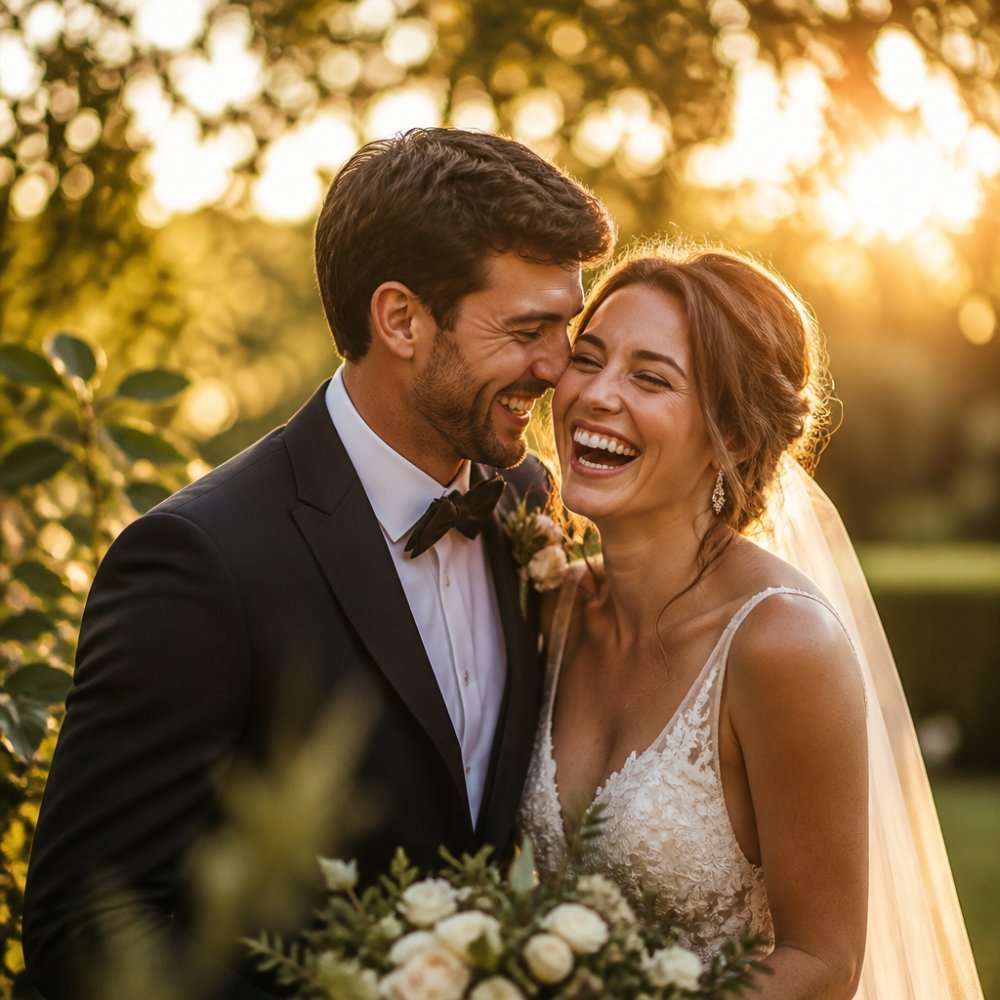
When you’re stuck in dim indoor light, shoot toward any light source, a window, a doorway, an uplighting rig. Backlighting and side-lighting create dimension and separate subjects from backgrounds far better than flat front-lighting.
Movement, Anticipation, and Fleeting Moments
Candid photography is about anticipation. You’re not reacting to moments, you’re predicting them and being ready when they arrive.
Watch for patterns. The best man always tells a story that makes the groom laugh. The mother of the bride always gets emotional during the toasts. The couple always shares a private moment right before walking into the reception. Once you recognize these patterns, you can position yourself ahead of time and be ready when the moment peaks.
Movement creates candid moments. Static poses look staged. Movement looks real. Watch for moments when people are transitioning, walking from one space to another, reaching across a table, turning to look at someone. These micro-movements often contain more genuine emotion than posed moments.
The most fleeting moments last less than a second. A genuine smile, a tear, a surprised expression. You can’t capture these by accident. You have to be locked on your subject, anticipating the peak of emotion, and ready to fire before it passes. This is why shooting in burst mode during emotional moments (toasts, vows, first kiss) is essential. You’ll miss most of the frames, but you’ll catch the one where genuine emotion crests.
Stay mobile. Don’t plant yourself in one location and expect moments to come to you. Move around the venue. Change your angle. Get low, get high, position yourself in unexpected places. The more angles you shoot from, the more moments you’ll find.
Creating Your Candid Wedding Photography Shot List
A shot list is your roadmap for the day. It ensures you capture the essential moments while leaving room for spontaneity. The best shot lists balance must-haves with flexibility.
Start with the non-negotiables: the couple getting ready, the first look (if they’re doing one), the ceremony, the recessional, family formals, the reception entrance, toasts, first dance, cake cutting, and the exit. These are moments that happen once and can’t be repeated.
Then add moments that are likely but not guaranteed: the bride’s father’s reaction during the ceremony, the couple’s first dance, genuine laughter during toasts, candid moments between guests. These happen at most weddings but not always with the same emotional intensity.
Leave at least 30 percent of your shooting time unscheduled. This is your buffer for moments you didn’t predict. The unexpected hug between old friends. The genuine moment of joy when the couple sees their decorated reception space for the first time. The quiet moment between the couple before everything gets hectic.
| Moment | Timing | Location | Priority |
|---|---|---|---|
| Getting ready | 30 min before ceremony | Bride and groom suites | Essential |
| First look | 15 min before ceremony | Predetermined location | If planned |
| Ceremony | Scheduled time | Ceremony space | Essential |
| Family formals | After ceremony | Ceremony location | Essential |
| Couple portraits | Golden hour | Outdoor venue | Essential |
| Reception moments | During reception | All spaces | High |
| Toasts and reactions | During dinner | Reception hall | Essential |
| First dance | Scheduled time | Dance floor | Essential |
| Candid guest moments | Throughout day | All spaces | Medium |
Post-Production Workflow for Candid Shots
Your work doesn’t end when the ceremony finishes. Post-production is where candid wedding moments get refined and polished.
Start by culling ruthlessly. You’ll have thousands of images. Delete every blurry shot, every duplicate, every frame where someone’s eyes are closed. This process is tedious but necessary. You’re left with only the keepers, images worth showing.
Organize your keepers by moment type: getting ready, ceremony, portraits, reception, candid moments. This organization makes it easier to find specific images later and helps you see patterns in what you captured well and what you missed.
Editing candid wedding moments is different from editing posed portraits. You’re not trying to make skin look perfect or eyes pop artificially. You’re enhancing the natural emotion already present in the frame. Increase contrast slightly to add punch. Warm the color temperature to match the mood. Reduce highlights to preserve detail in bright areas. Keep your edits subtle and consistent across all images.
Many photographers shoot in flat picture profiles or log formats to preserve maximum detail in post-production. This gives you flexibility when editing but requires more work during the editing process. If you’re new to post-production, shoot in your camera’s standard profile and make smaller adjustments.
Batch editing, applying the same adjustments to similar images, saves time. Edit one image from the getting-ready section, then apply those settings to all similar images from that section. Adjust as needed for different lighting conditions.
Post-production for candid wedding moments is about enhancement, not transformation. You’re making good moments great, not saving bad moments. If an image doesn’t work in its raw state, no amount of editing will fix it.
Common Mistakes to Avoid
The difference between good candid wedding photography and great candid wedding photography often comes down to avoiding predictable mistakes.
Being too intrusive. Hovering directly in front of people, constantly calling for attention, or positioning yourself in the middle of moments. Stay on the edges. Let moments happen without your presence feeling heavy.
Missing the peak of emotion. You’re focused on technical settings instead of watching for the moment. The best candid wedding moments happen in the space between conscious poses. Watch people’s faces, not your camera settings.
Using settings that don’t match the environment. Shooting at f/5.6 in dim light means high ISO and slow shutter speeds. Shooting at 1/60 second means motion blur. Know your environment and adjust your settings before you need them.
Neglecting backup equipment. One battery, one memory card, one lens. When something fails, you’re done. Bring redundancy.
Shooting only wide shots or only tight crops. Variety in framing tells a more complete story. Mix environmental portraits with close-ups. Mix wide shots with compressed telephoto perspectives.
Ignoring the couple’s preferences. Some couples want lots of couple portraits. Others want the focus on guests and candid moments. Ask what matters to them and adjust your approach.
Capturing candid wedding moments requires technical preparation, strategic positioning, and genuine interest in the people in front of your camera. The technical part, camera settings, lens selection, light management, is learnable and repeatable. The human part, building trust, anticipating moments, staying invisible while staying present, comes from practice and intention.
Start with solid fundamentals: fast shutter speeds, wide apertures, and reliable prime lenses. Position yourself where authentic moments are likely to happen. Build trust with your couple so they relax in front of the camera. Then step back, stay alert, and let the moments come to you. The best candid wedding photography happens when you’re technically ready and emotionally present.
Frequently Asked Questions
What camera settings are best for capturing candid wedding moments?
Use a fast shutter speed (1/250 second or faster) to freeze spontaneous movement, set ISO between 800-3200 depending on available light, and open your aperture to f/2.0-f/4.0 for shallow depth of field that isolates your subjects. These settings let you react quickly to fleeting moments without missing focus or motion blur. Adjust based on venue lighting, darker indoor spaces require higher ISO and wider apertures, while outdoor daytime events allow tighter apertures and lower ISO.
Which lenses work best for candid wedding photography gear?
Prime lenses with wide apertures excel at candid work. A 35mm f/2.0 or f/1.4 lens is ideal for environmental portraits and storytelling, capturing the couple within their surroundings. A 50mm f/1.8 or f/1.4 works for closer, more intimate moments. A 85mm f/1.4 is excellent for compressed, emotional reactions. For low-light receptions, choose lenses with f/2.0 or wider apertures to gather enough light without pushing ISO too high. Zoom lenses (24-70mm) sacrifice aperture width but offer flexibility when you cannot move freely.
How do you remain invisible while capturing authentic moments?
Position yourself to the side or slightly behind the action rather than directly in front. Use longer focal lengths to photograph from a distance, reducing your visual presence. Blend into the background by wearing neutral colours and avoiding sudden movements. Anticipate moments before they happen, watch for emotional cues, body language shifts, and reactions, so you’re ready without calling attention. Let guests forget you’re there by staying still between shots and avoiding constant camera adjustments.
What should a candid wedding photography shot list include?
Create a list covering key emotional beats: pre-ceremony preparations, first-look reactions, ceremony vows and tears, ring exchange close-ups, recessional joy, cocktail hour candids, reception toasts and laughter, first dance reactions from guests, cake-cutting moments, and departure spontaneity. Include environmental portraits showing the venue and decor. Note specific people or family groups you want to capture unaware. Prioritise reaction shots over posed ones, capture the grandmother wiping tears, friends laughing, the groom’s genuine smile, these authentic moments tell the wedding’s true story.